Curiosities
Curiosities is a personal cabinet of the interesting, unusual, beautiful, and occasionally strange things I've picked up, photographed, or stumbled across while traveling. It is part gallery, part history lesson, and part rabbit hole: a place for objects, artifacts, and discoveries that make you stop, look closer, and wonder what story they carry.
The specimens here are not random. Each one has a provenance: a mine, a market, a castle cellar, a classroom, or a field trip. I photograph every piece myself in natural light, research the geology or history behind it, and write the kind of note I would want to read in a museum label, only with more personality and fewer parentheses. If I can't verify an origin or story, I say so.
What you'll find in this cabinet
- ·Geology & minerals: rocks and crystals I've collected or bought on location, with formation notes, age estimates, and honest provenance.
- ·Tales & random musings: odd stories, historical objects, and off-the-beaten-path observations that don't fit anywhere else.
- ·Food & drink: deep dives into culinary traditions, recipes, and spirits from the places I've visited.
- ·Certifications & badges: the proof-of-fun credentials earned on the road, from whiskey tastings to flight schools, presented with context rather than résumé polish.
I don't accept sponsored placements for objects or experiences in this section. Gifts from hosts or friends are disclosed in the post. Opinions are my own, and if you click a link to a retailer, it is an ordinary link, not a paid endorsement.
Geology: My Rocks & Minerals
A personal cabinet of deep-time geological wonders and specimens.
Tales: Stories & Musings
Reflections and odd tales gathered from off-the-beaten-path voyages.
Travel Artifacts
Objects, keepsakes, and oddities carried home from the road.
Culinary: Food Blog
Taste the world through recipes, food history, and local dining.
Spirits: Mixology
A field guide to national pours, signature spirits, and local drinks.
Fun: Certifications
Quirky proof-of-experience certificates from global adventures.
Curating the Wonders of the Earth
"There is a quiet joy in holding a piece of history that is millions of years old. Every crystal structure, every perfect cleavage plane, and every mineral inclusion tells a story of intense pressure, heat, and time on a scale we can barely comprehend."
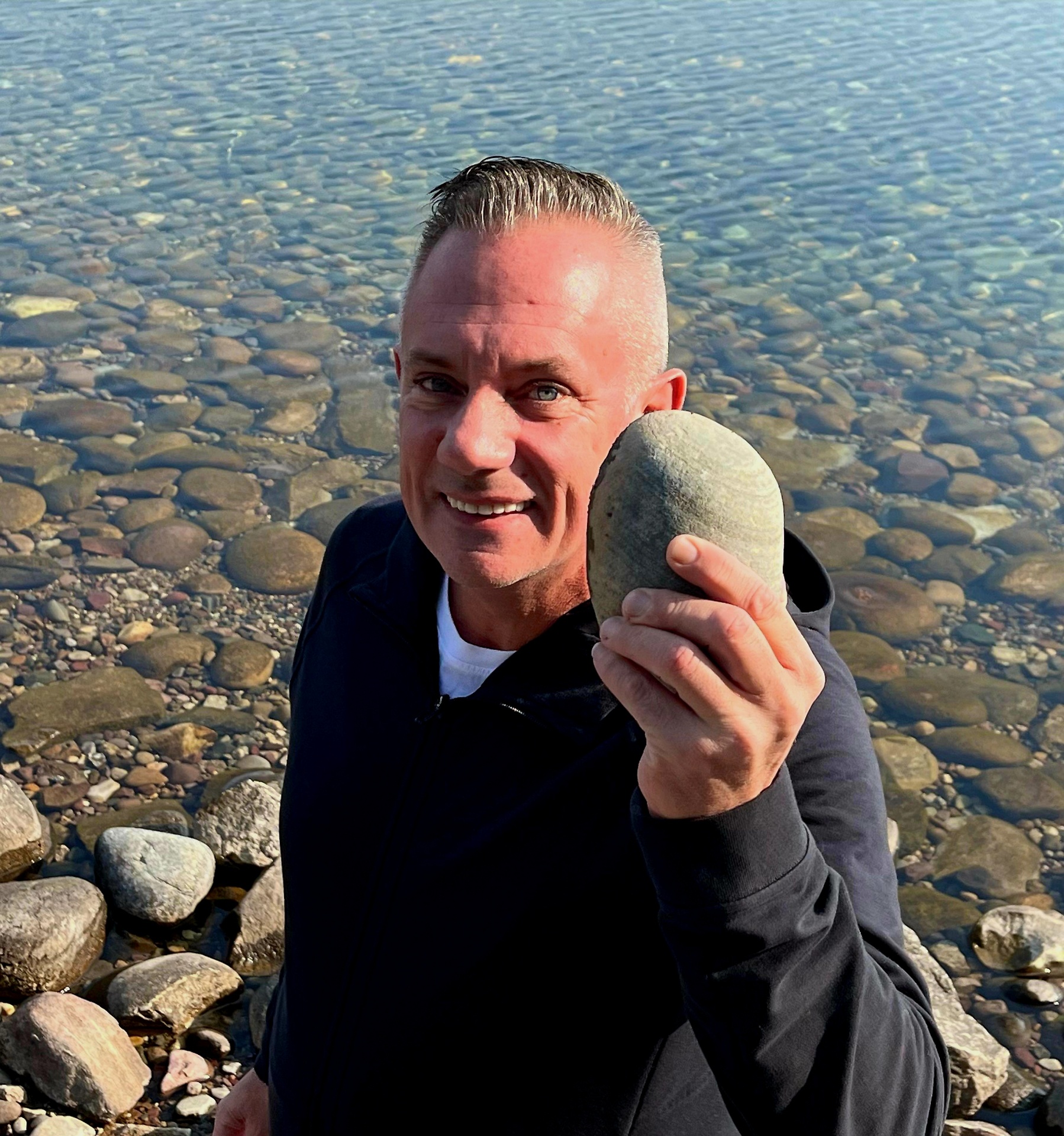
My Rock & Mineral Collection
As an avid purveyor of rocks and minerals, I've spent years gathering specimens that showcase the planet's wildest geometric, chemical, and physical designs. Each piece in this digital cabinet is a remarkable chapter of natural history, hand-selected for its unique story, structural beauty, or geological curiosity.
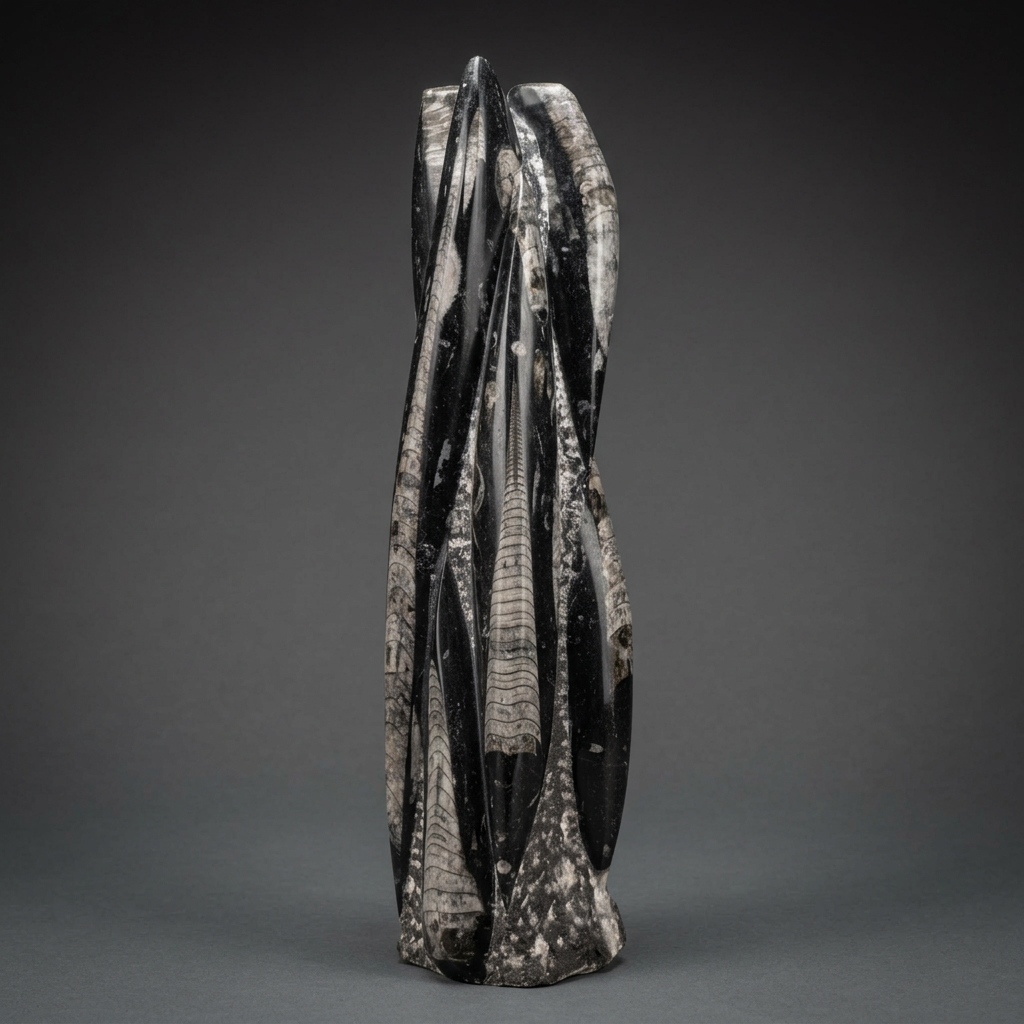
Orthoceras Fossil Sculpture
Atlas Mountains, Morocco · Ordovician Period
A hand-carved sculpture quarried from the black limestone beds of Morocco's Atlas Mountains, where ancient seafloor sediments preserved entire colonies of orthoceras: straight-shelled cephalopods that drifted through the world's oceans roughly 400 to 470 million years ago, during the Ordovician and Silurian periods. These extinct relatives of modern squid and nautilus grew chambered conical shells, several of which are visible here in cross-section, each segment marking a stage of life sealed off as the animal grew forward into a new chamber. The deep black matrix is fossiliferous limestone, polished to a mirror finish to reveal the calcite-replaced shells in pale contrast. A piece of deep-time held in the hand, equal parts paleontology and stone sculpture.
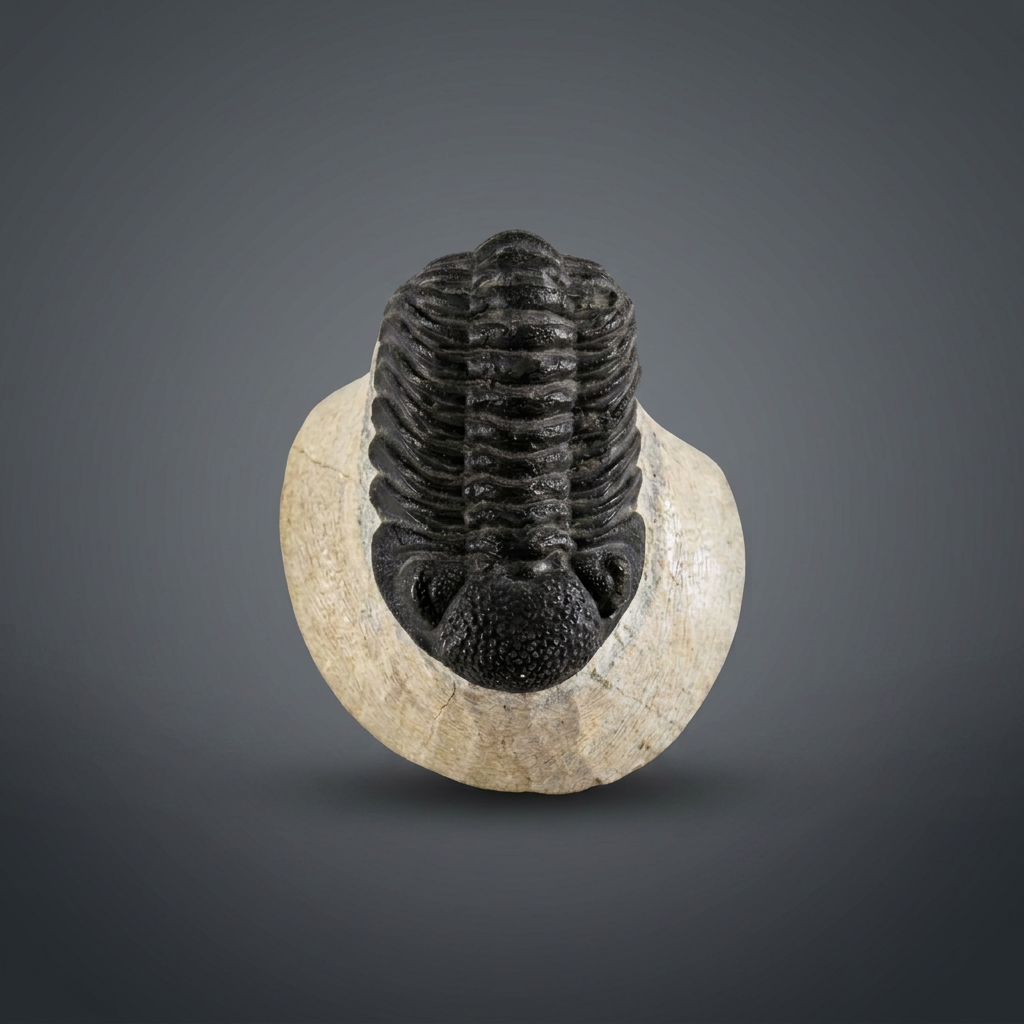
Trilobite Fossil
Atlas Mountains, Morocco · Devonian Period (roughly 390 million years)
A fossilized trilobite prepared out of the limestone beds of Morocco's Anti-Atlas region, likely a Devonian phacopid, recognizable by the wide crescent-shaped headshield, the bulging schizochroal compound eyes, and the neatly ribbed thorax that tapers into a rounded tail. Trilobites were among the great success stories of the Paleozoic, marine arthropods that ruled the seafloor for nearly 270 million years, evolved thousands of species, and then vanished at the end of the Permian along with roughly ninety percent of life on Earth. Here is the curious bit. Most trilobite fossils you see are not whole animals at all. Like modern crabs, lobsters, and horseshoe crabs, trilobites had to molt their rigid calcite exoskeleton in order to grow, splitting the shell along suture lines and crawling out slightly larger and defenseless for a few hours. Each animal shed a dozen or more times in its life, so for every trilobite that died and fossilized intact, it left behind a small graveyard of discarded headshields, loose thoracic segments, and empty tails scattered across the sea floor. That is why complete, articulated specimens like this one are the prize, not a shed suit of armor, but the actual creature, caught mid-crawl and preserved in stone for four hundred million years.
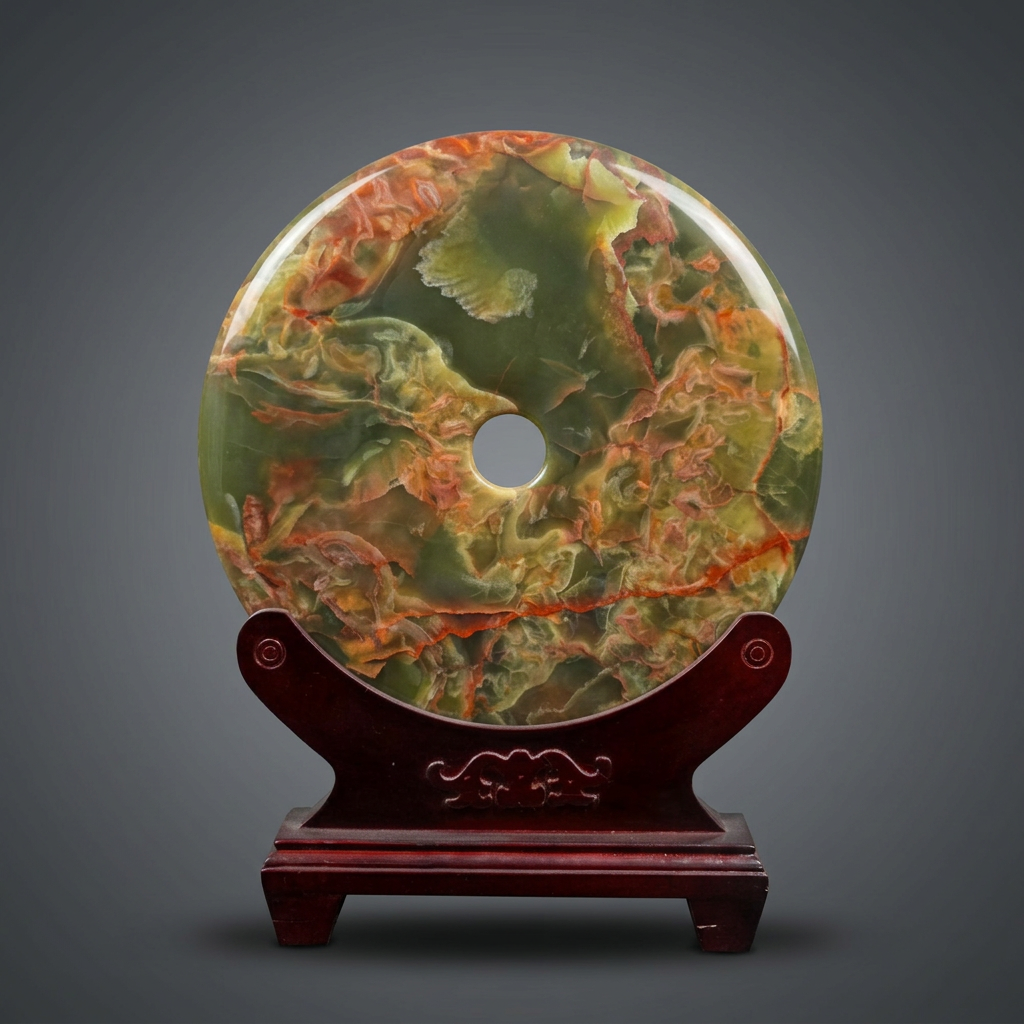
Carved Jade Bi Disc
Purchased in Vietnam · Nephrite-type jade on rosewood stand
One of my favorite pieces in the cabinet: a large polished bi disc, the ancient ring-with-a-hole form that has been carved in jade across East and Southeast Asia for more than five thousand years. Bi discs were burial and ritual objects, symbols of heaven, of continuity, of the circle that never ends, and the shape has survived into modern carving almost unchanged. The stone itself is a wonderfully unruly one. Where classic imperial jade is a uniform green, this disc is a landscape: mossy olive and celadon fields interrupted by rust-orange and salmon veining where iron-bearing fluids worked their way through fractures in the rock long before anyone thought to cut it. Jade is really two minerals sold under one name, nephrite (a calcium magnesium amphibole) and jadeite (a sodium aluminum pyroxene), and both owe their toughness to a dense felted or interlocking crystal structure that makes jade harder to break than steel of the same thickness, even though it is softer to scratch. That toughness is exactly why it could be worked into thin, wide, perfectly drilled discs like this one with nothing more than abrasive sand and patience. Bought in Vietnam and displayed on its original carved rosewood stand, it reads as half geology, half heirloom.
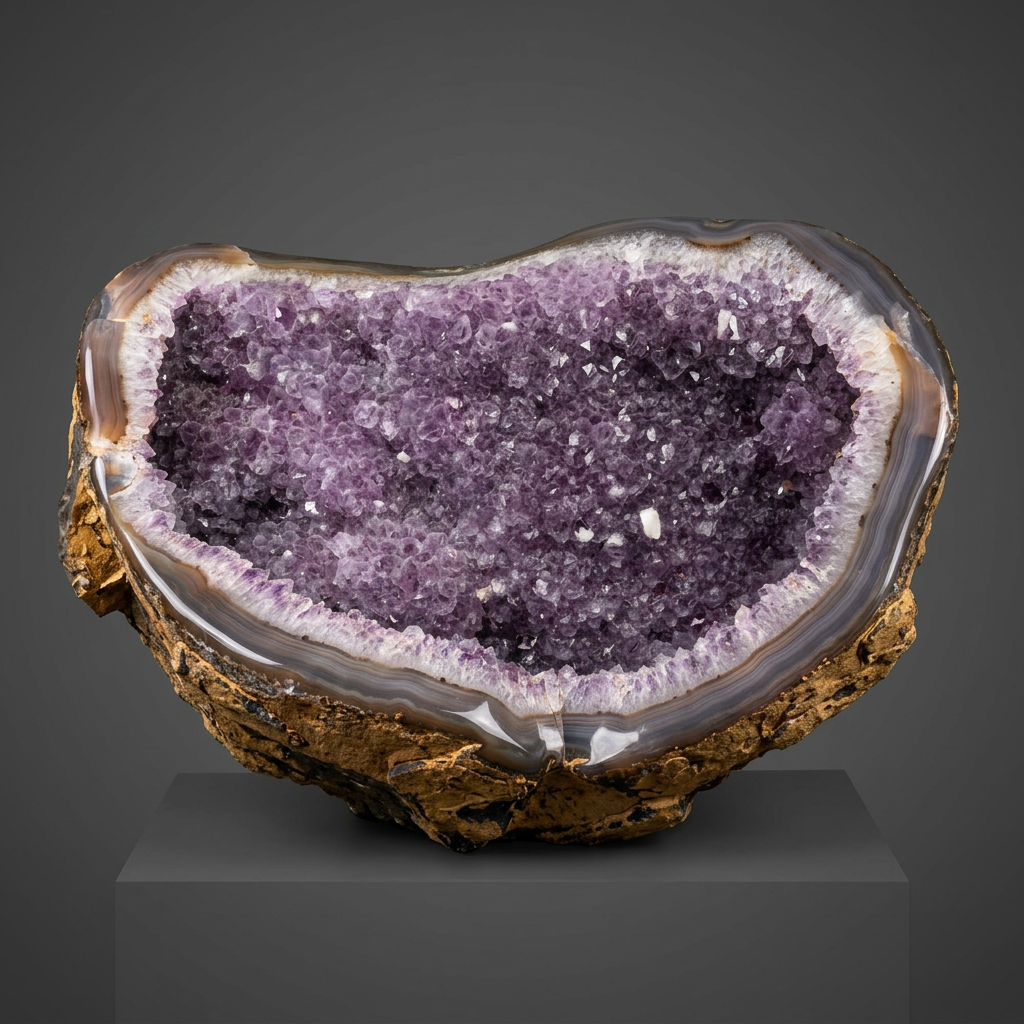
Amethyst Geode (35 lbs)
Rio Grande do Sul, Brazil · Cretaceous Basalt Flows
A thirty-five pound amethyst geode lined with a dense druzy of violet quartz crystals, framed by a banded agate rim that fades from translucent gray to milky white. Geodes like this one formed roughly 130 million years ago inside gas bubbles trapped in the basaltic lava flows of the Paraná Plateau in southern Brazil. Over millions of years, silica-rich groundwater seeped through the volcanic rock and slowly crystallized inward, first as agate bands along the cavity wall, then as quartz, and finally as the iron-tinted purple amethyst that gives the geode its color. Amethyst owes its violet hue to trace iron impurities altered by natural gamma radiation deep within the Earth. A small piece of Cretaceous volcanism, cracked open to reveal what time and chemistry quietly built inside.
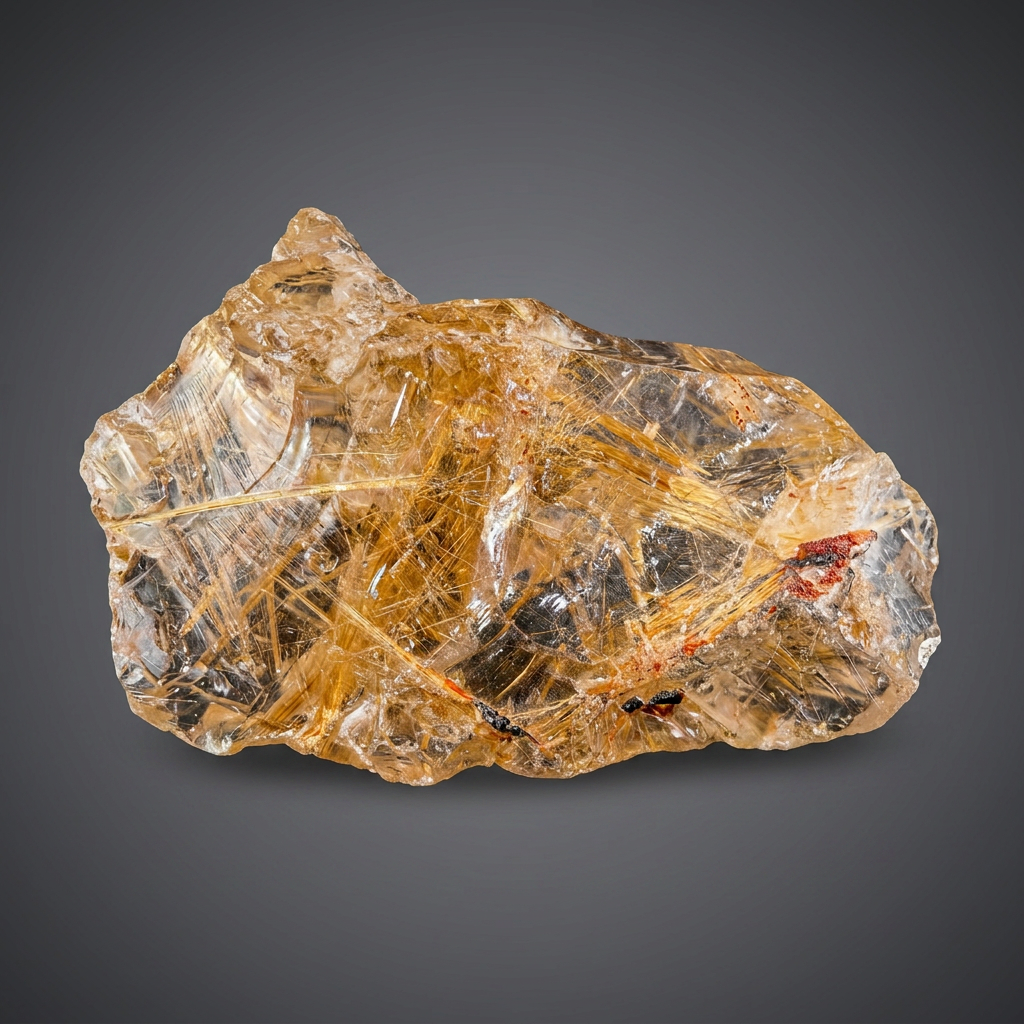
Rutilated Quartz
Quartz with Rutile Inclusions
Rutilated quartz, a clear to smoky quartz specimen threaded with fine golden, copper, or reddish needle-like inclusions of rutile. The internal strands look almost like frozen sparks, giving the piece a natural 'lightning in glass' effect. Quartz is already one of the great workhorses of the mineral world, but add rutile and it suddenly gets a dramatic wardrobe upgrade.
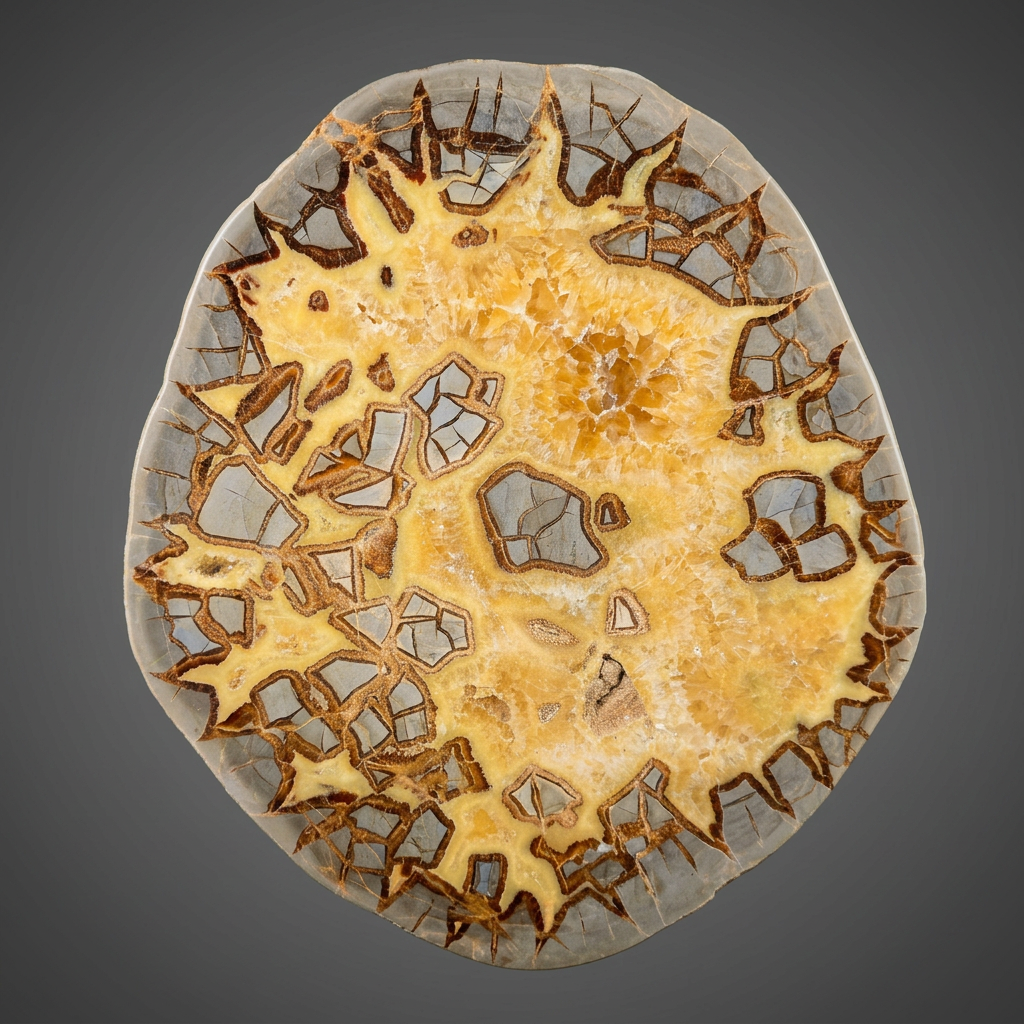
Septarian Nodule
Ancient Seafloor Sediment
This polished septarian nodule, often nicknamed 'dragon stone,' looks like a frozen lightning storm trapped in rock. Its bold network of brown mineral-filled cracks separates creamy yellow calcite from gray limestone or mudstone, creating the dramatic pattern that makes septarian pieces so collectible. These nodules formed millions of years ago as ancient seafloor sediments hardened, cracked, and were later filled by minerals carried through groundwater. The result is part geology, part natural stained glass, and part prehistoric puzzle, one the Earth took its sweet time assembling.
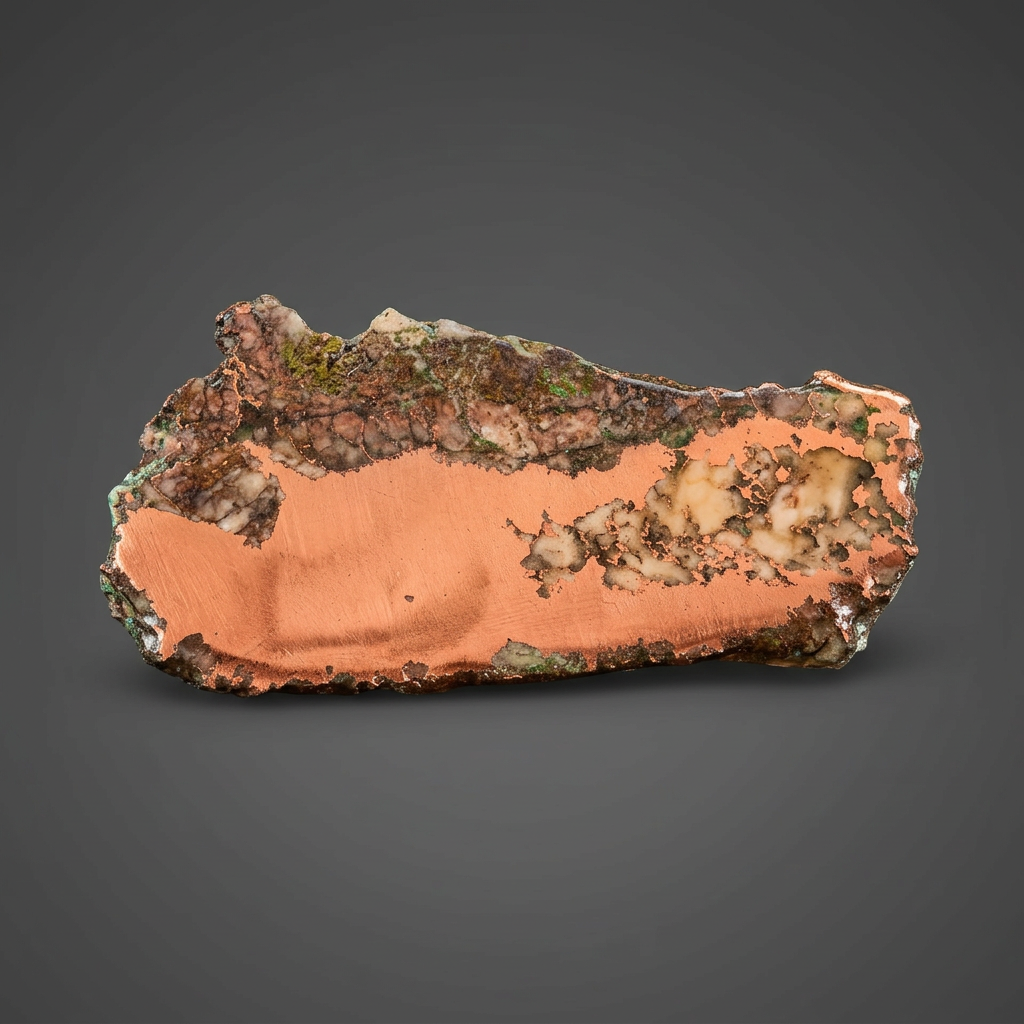
Native Copper
Raw Native Metal
Native copper, showing a bright metallic copper face with darker oxidized edges and possible greenish copper minerals along the surface. Copper is one of humanity's oldest worked metals, prized for its color, conductivity, and usefulness, but in raw mineral form it has a beauty of its own. The contrast between the polished coppery sheen and the rugged outer matrix gives this piece the look of a metal vein sliced straight from the Earth.
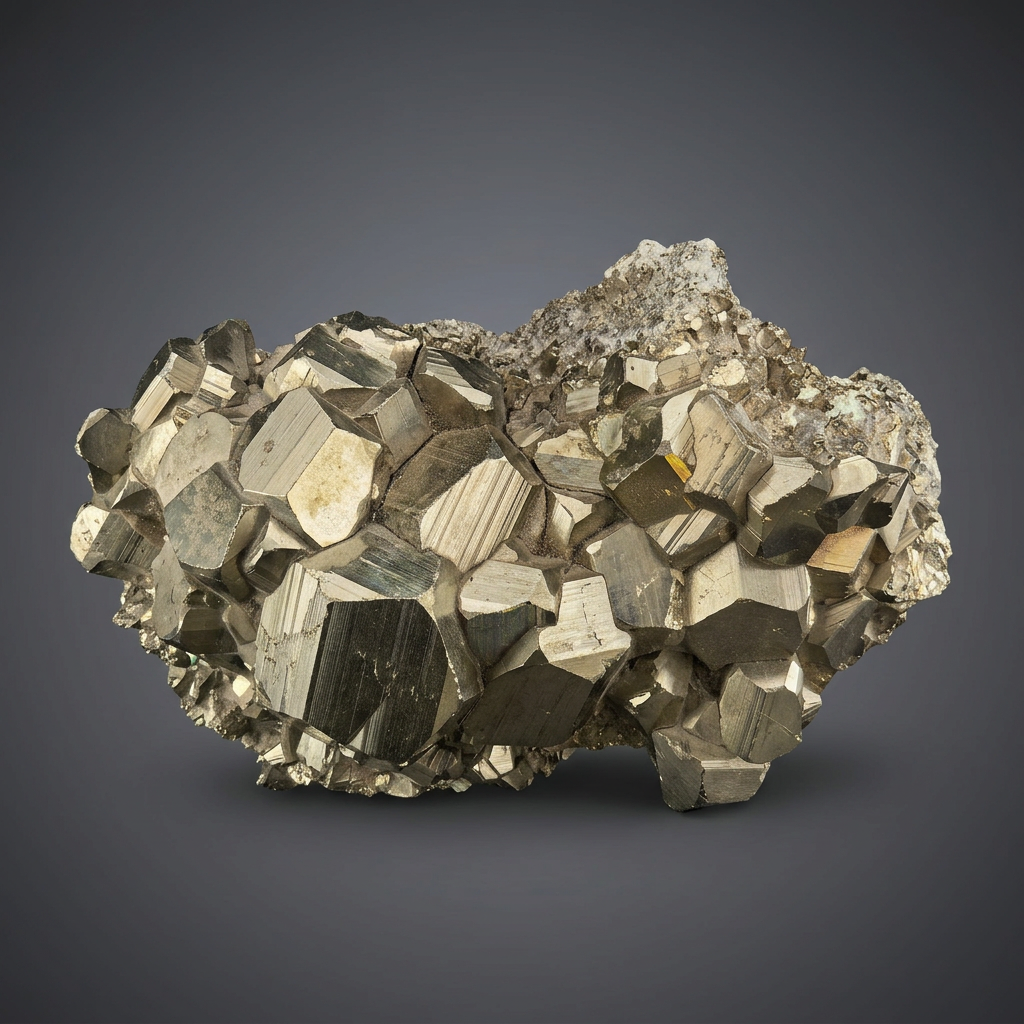
Pyrite Specimen
Crystalline Cluster
A Pyrite specimen displaying the brilliant metallic luster and brass-yellow hues that earned this mineral its famous nickname, 'fool's gold.' While easily mistaken for gold at first glance, pyrite has a distinct character all its own: sharp crystal faces, a heavy geometric structure, and an intricate, almost architectural sparkle. Formed of iron disulfide, pyrite frequently crystallizes in perfect cubes, dense clusters, and complex aggregates like this one. It may not be gold, but it certainly knows how to dress for the part.
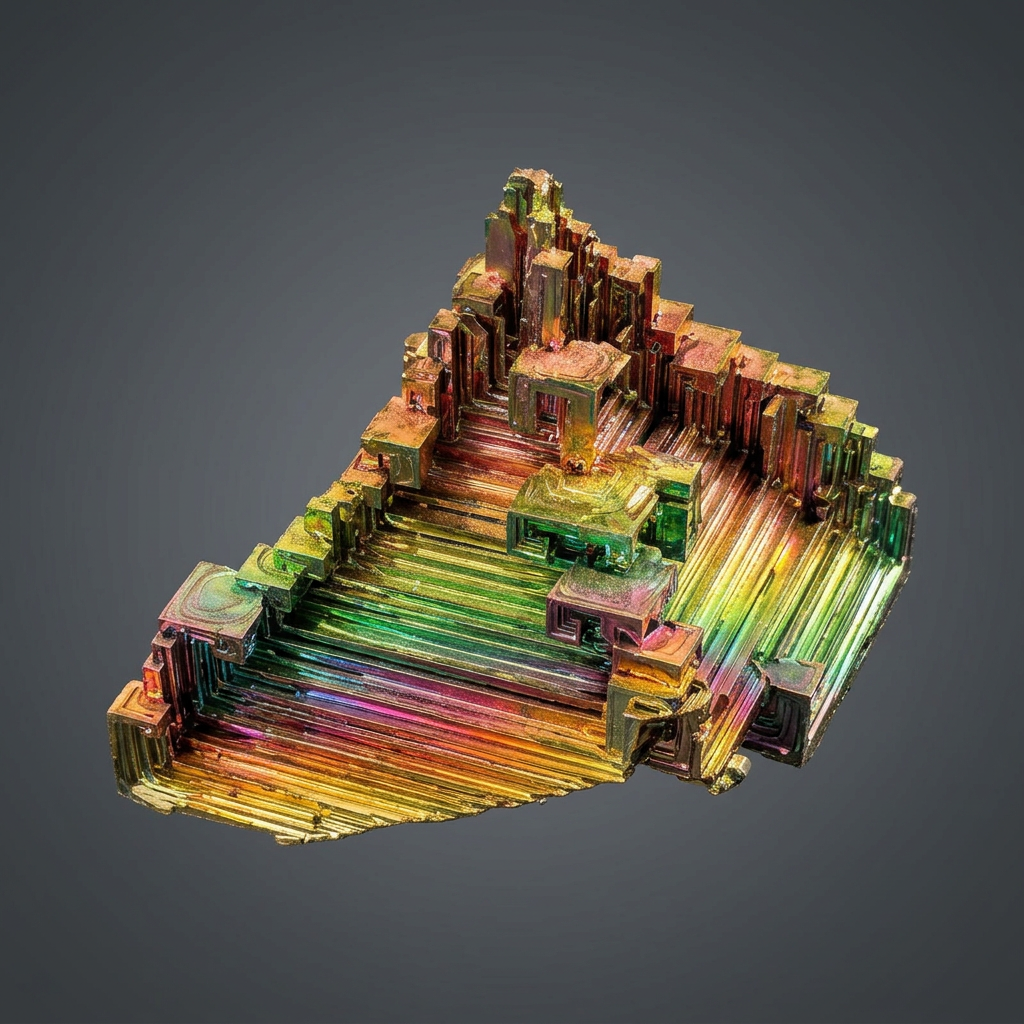
Bismuth Crystal
Lab-grown specimen
A bismuth crystal with the unmistakable stair-stepped 'hopper' growth: the edges race ahead of the center, leaving a miniature metallic city of terraces, ledges, and towers. The rainbow sheen is not paint but a thin oxide layer that bends light into shifting yellows, greens, pinks, and blues. Bismuth is heavy, brittle, and melts at a low temperature, which makes specimens like this a favorite of collectors, science lovers, and anyone who appreciates it when geology decides to show off.
Travel Artifacts
Objects picked up on the road: souvenirs with a story, market finds, cultural keepsakes, and the occasional oddity that had to come home in the carry-on. Each piece is photographed in the same studio style as the geology collection, with notes on where it came from and why it made the trip.
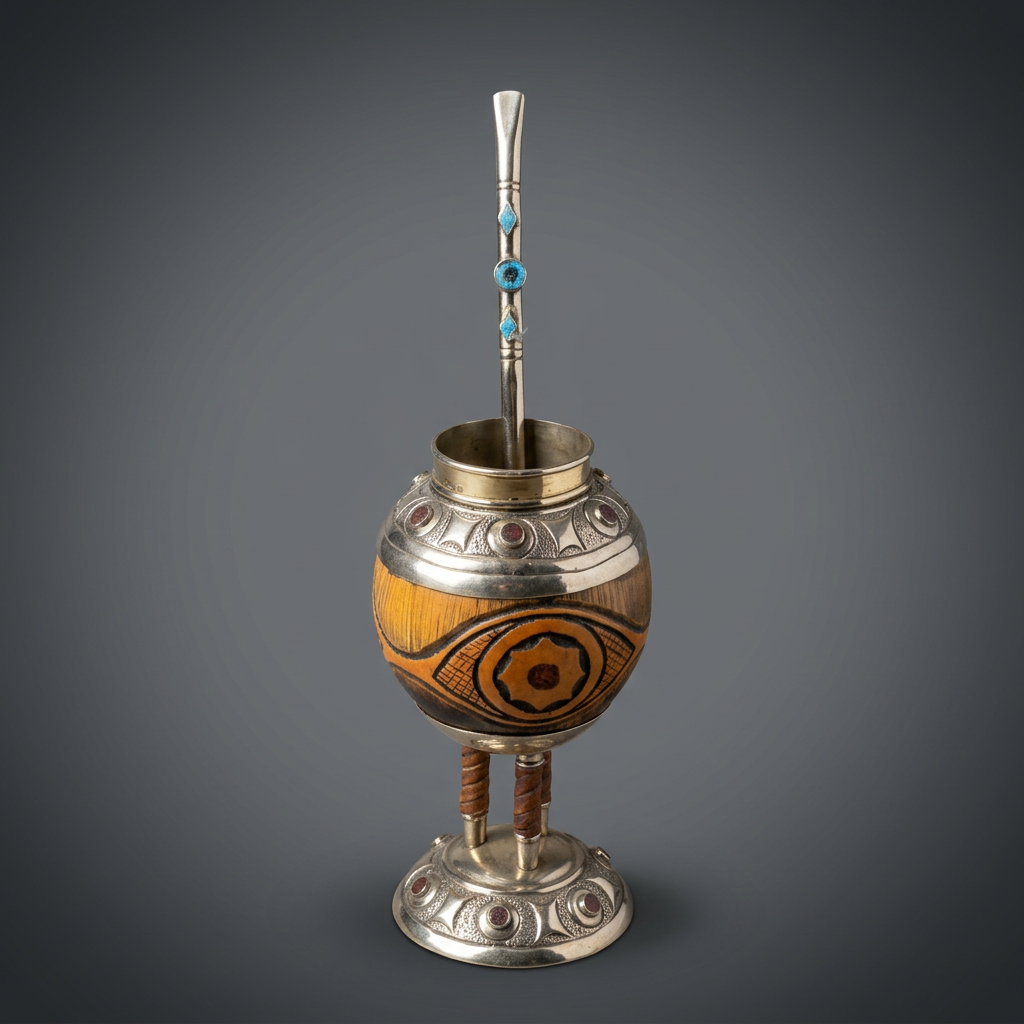
Silver-Mounted Mate Cup & Bombilla
Argentina · Traditional mate craftsmanship
A mate set brought home from travels in Argentina, where drinking yerba mate is less a beverage choice and more a social ritual. The cup itself is a natural, dried calabash gourd, its skin hand-carved with pyro-engraved patterns and wrapped in ornamental alpaca silver, a durable nickel alloy that takes a bright polish. This pedestal, or footed, style raises the gourd above the table and frames it with chased metalwork. The bombilla, the metal straw used to sip mate without swallowing the leaf, has a built-in filter at the bottom and is decorated here with turquoise-colored stone accents. Together they are the classic Argentine kit: the gourd for the herb, the straw for the pour, and the shared circle of friends for the conversation.
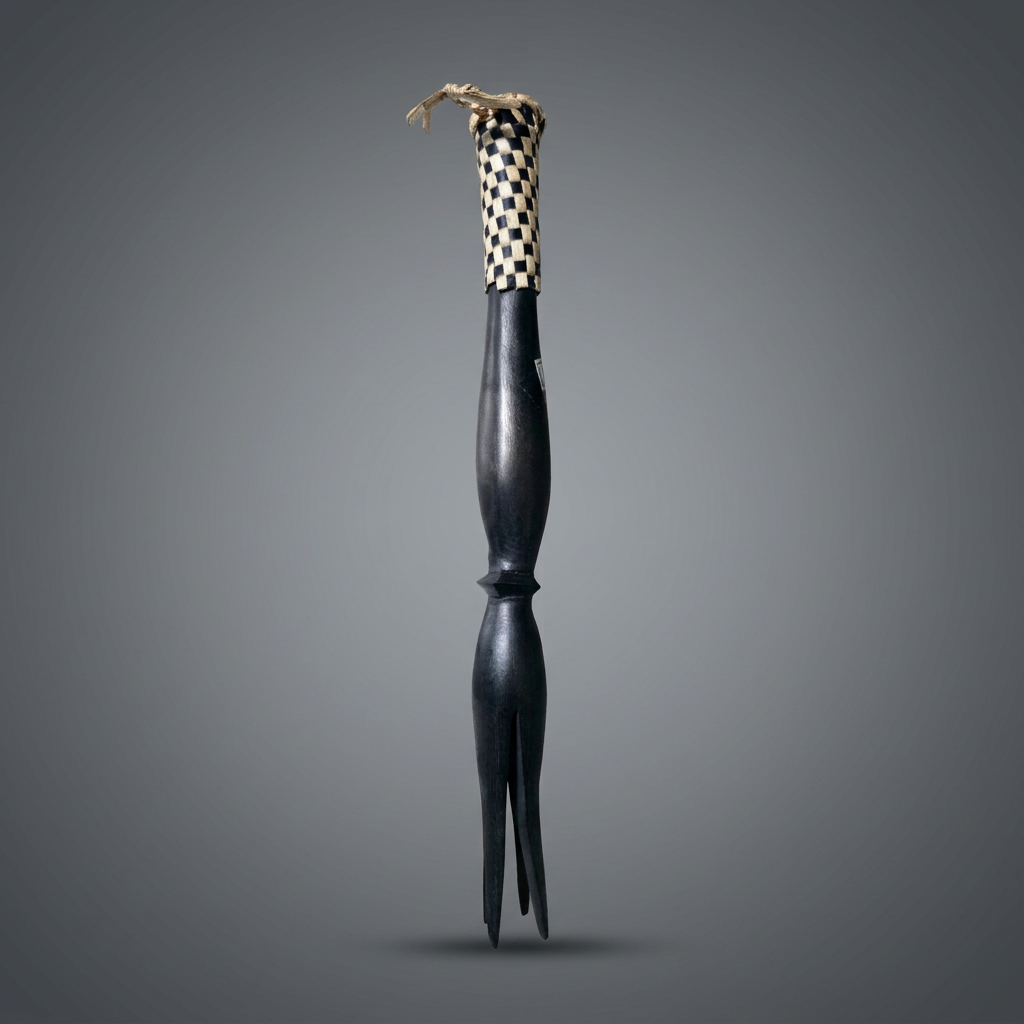
Fijian Cannibal Fork (iCula)
Fiji · Traditional carved hardwood
Known in Fijian as iCula, the cannibal fork is one of the most storied objects in Pacific material culture. Hand-carved from dense native hardwood and finished here with a woven pandanus wrap at the handle, these forks were historically used in ritual feasts by chiefs and priests, who were forbidden from touching sacred flesh, including the flesh of a defeated enemy, with their own hands. Cannibalism in pre-Christian Fiji was bound up with warfare, mana, and revenge rather than sustenance, and the iCula was the ceremonial tool that kept the tapu, or sacred prohibition, intact. Missionary contact in the 19th century largely ended the practice, but the forks endure as carved reminders of a complicated chapter of Fijian history and remain one of the islands' most recognizable traditional forms.
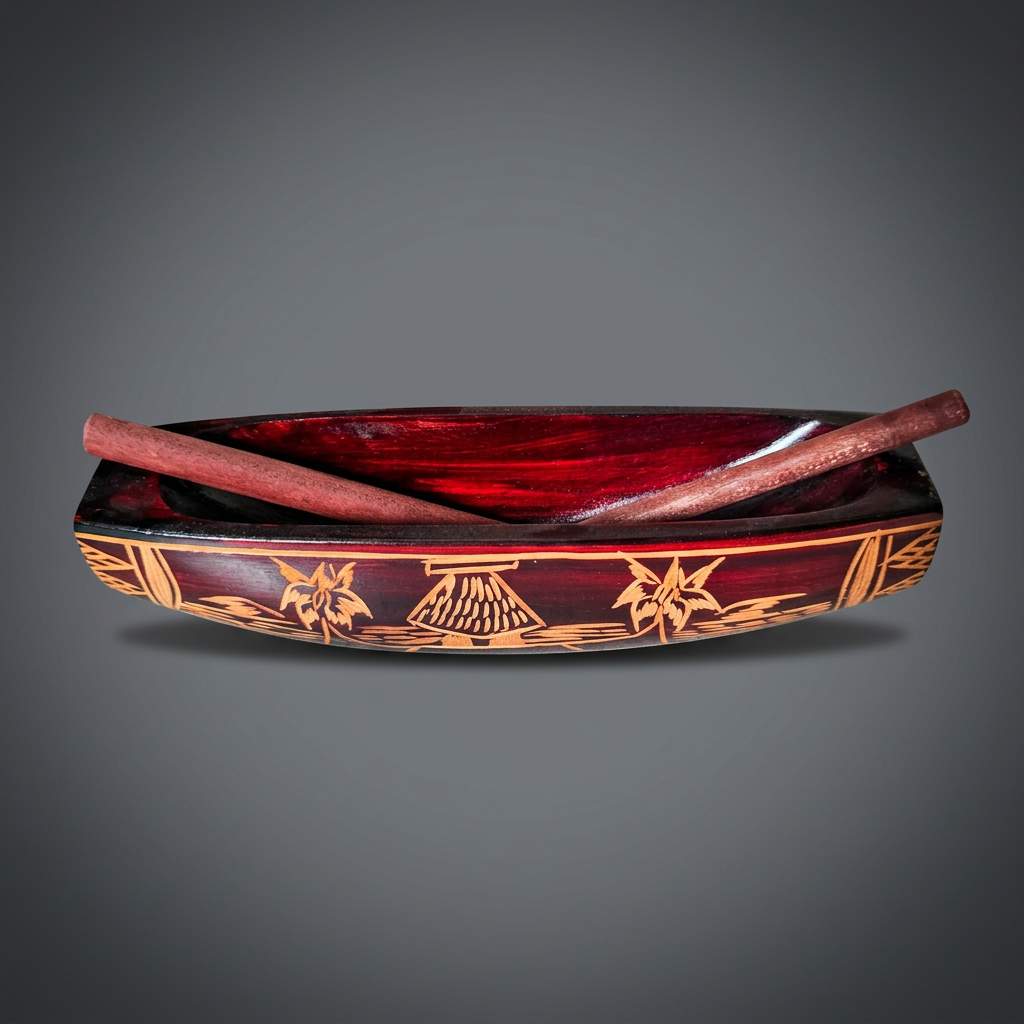
Carved Canoe & Paddles (Camakau)
Fiji · Hand-carved red-stained hardwood
A hand-carved miniature of the Fijian camakau, the fast single-outrigger sailing canoe that carried people, goods, and news between the islands long before ferries and roads existed. The hull is turned from a single piece of hardwood and finished in a deep red stain, with the sides pyro-engraved in pale relief: thatched bure houses, palm fronds, and stylized floral motifs that read like a map of village life. Two carved paddles rest inside the hull. Full-sized camakau were built without nails, lashed together with sennit (braided coconut fiber), and prized for their speed under a lateen-style sail. This piece keeps that seafaring lineage alive in the palm of the hand.
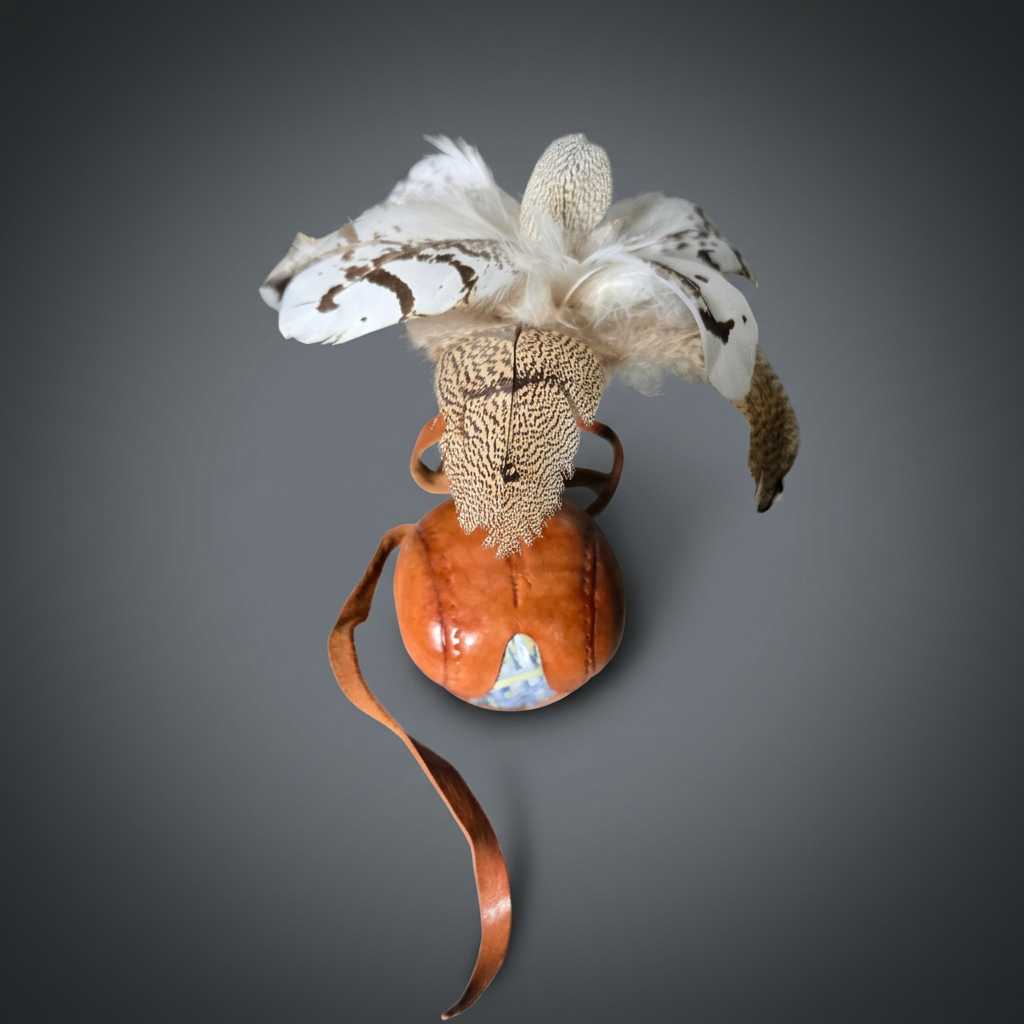
Falcon Hood (Burqu)
Doha, Qatar · Traditional falconry craftsmanship
A hand-stitched leather falcon hood, known in Arabic as a burqu, picked up in Doha where falconry is not a hobby but a national inheritance recognized by UNESCO as intangible cultural heritage. The hood is fitted over the bird's head to keep it calm between flights, blocking sight without touching the eyes so the falcon can rest, travel, and be handled without stress. This one is built in the Arab style: soft orange leather sewn in two panels, a small painted inlay at the beak opening, and a topknot of speckled feathers that doubles as a handle for the falconer's fingers when slipping the hood on and off. Two long braces trail from the crown; a gentle tug on both at once opens the hood in a single motion, the quiet cue that says it is time to hunt.
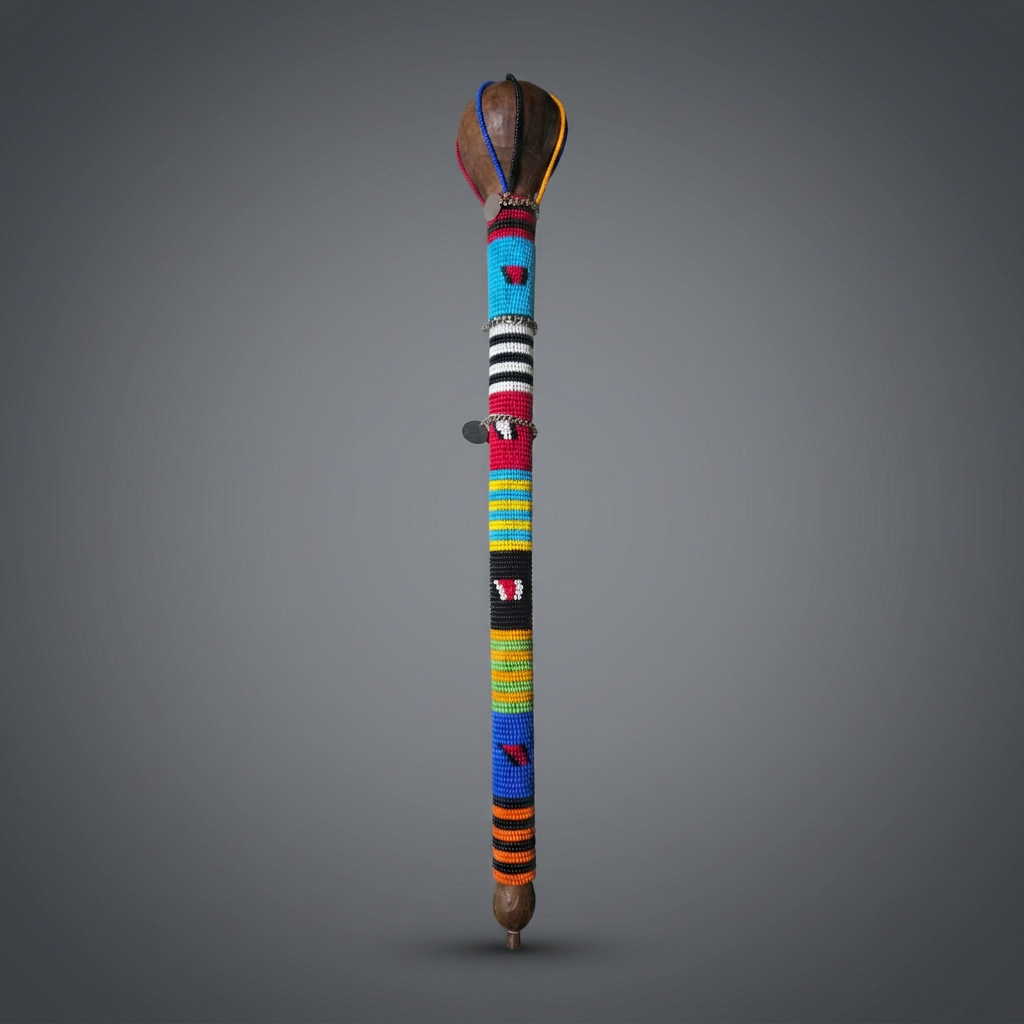
Maasai Beaded Rungu
Kenya · Maasai beadwork tradition
A rungu, the short throwing and striking club that has been part of Maasai and Kalenjin life across Kenya and northern Tanzania for centuries. The head is turned from a single piece of dense hardwood, weighted at the knob so it flies true when thrown at small game or a rival's shield, and the shaft is sheathed here in tight bands of glass seed beads in the classic Maasai palette: red for bravery and the blood of cattle, blue for the sky and water, green for the land, yellow for hospitality, white for peace, and black for the people themselves. Small metal charms tinkle when it moves. Historically carried by warriors (morans) as both weapon and status object, the rungu now shows up at ceremonies, negotiations, and as an elder's speaking stick — whoever holds it holds the floor.
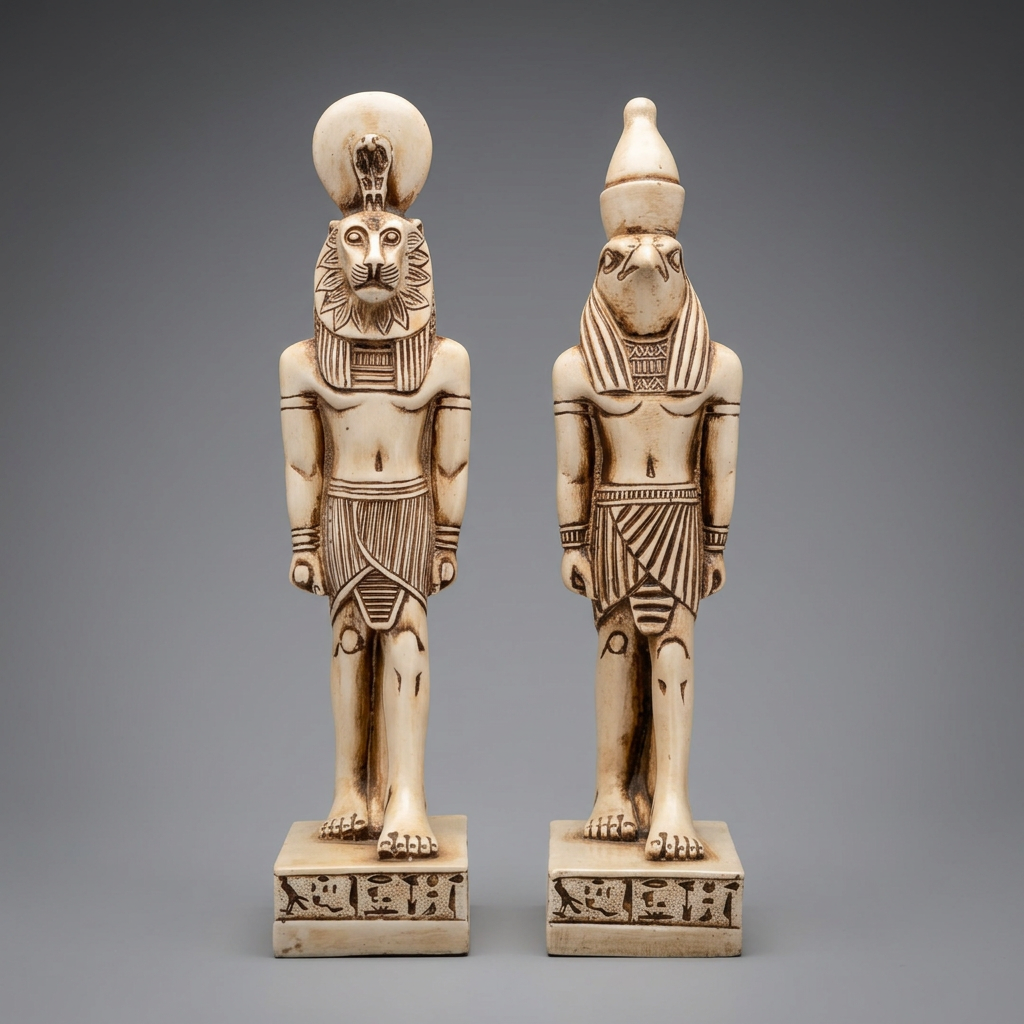
Sekhmet & Horus Statuettes
Egypt · Cast resin with antiqued patina
A matched pair of Egyptian deity statuettes picked up in Egypt, cast in cream-colored resin and rubbed with a brown antiqued patina to mimic the weathered limestone of temple reliefs. On the left is Sekhmet, the lioness-headed daughter of the sun god Ra, crowned with a solar disk and uraeus (rearing cobra); she is the goddess of war, plague, and healing, whose breath was said to create the desert and whose rage could only be calmed by red-tinted beer. On the right is Horus, the falcon-headed sky god and divine protector of the pharaoh, wearing the pschent — the tall white and red double crown that fused Upper and Lower Egypt into one kingdom. Both stand on plinths carved with mock hieroglyphs, dressed in the pleated shendyt kilt and broad usekh collar that identify them across three thousand years of Egyptian iconography.
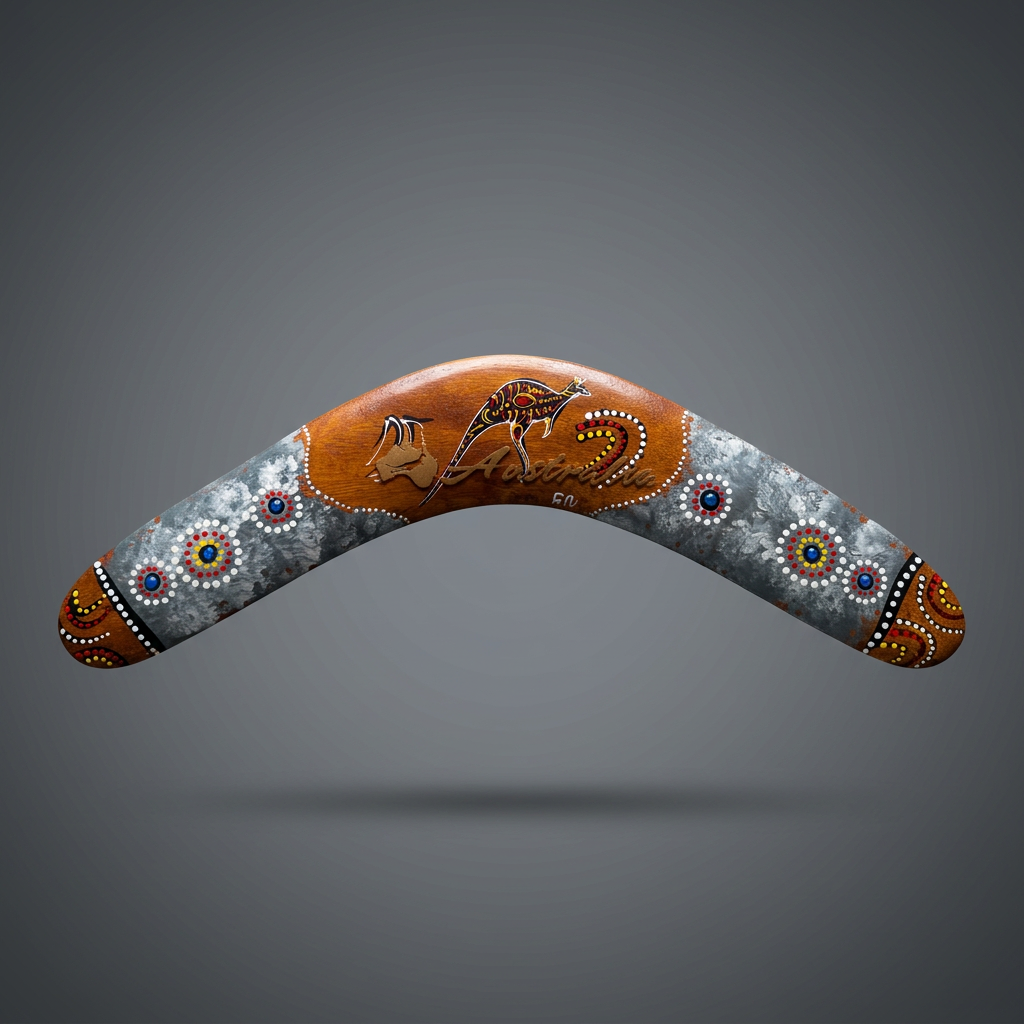
Hand-Painted Aboriginal Boomerang
Sydney, Australia · Aboriginal art reproduction by Eddy Harris
A returning-style boomerang picked up in Sydney, hand-painted in the tradition of Aboriginal dot art with a leaping kangaroo, a map of Australia, and concentric dot circles that in Aboriginal iconography often signal waterholes, meeting places, or campsites. The piece is a licensed reproduction by artist Eddy Harris, a Wiradjuri elder from Molong in outback New South Wales, with royalties supporting Aboriginal art and culture programs. The boomerang itself is one of humanity's oldest engineered tools, in continuous use across the Australian continent for at least ten thousand years. Contrary to the postcard version, most traditional boomerangs did not return: heavy hunting sticks were thrown straight and fast to bring down kangaroo, emu, and waterfowl. The lighter, curved returning boomerang — the shape shown here — was developed for sport, training, and flushing birds into nets, and remains a small aerodynamic miracle carved from a single piece of wood.
Certifications
A collection of quirky, hard-earned, and occasionally hilarious certificates picked up along the way: distillery tastings, perfect-pint pours, medieval spirits trials, and the odd hot-air balloon flight over the Masai Mara, Kenya. Proof that lifelong learning and education never has to be boring.
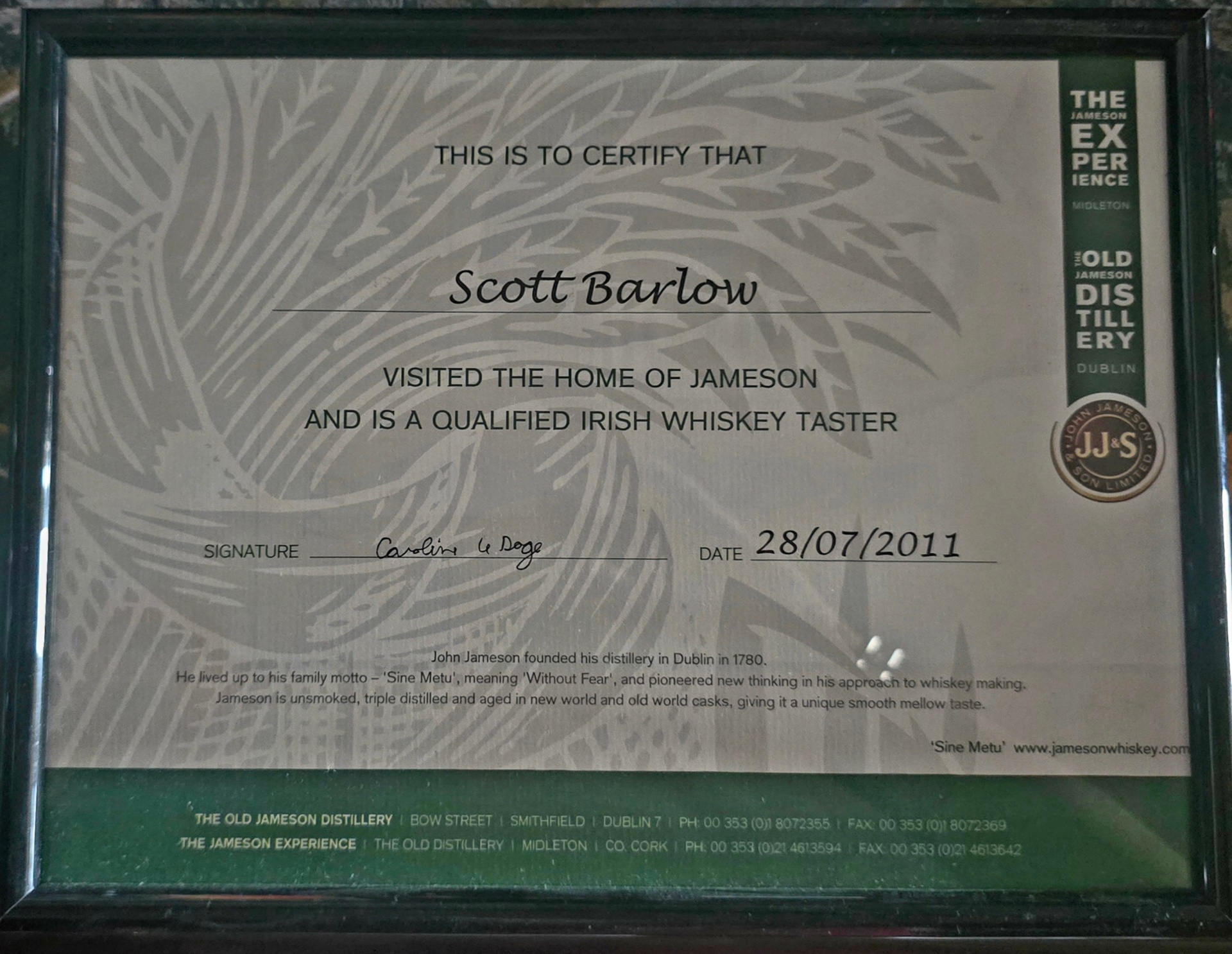
Qualified Irish Whiskey Taster
Old Jameson Distillery, Dublin · 28 July 2011
Awarded at the Old Jameson Distillery on Bow Street in Dublin after a guided tasting comparing Jameson against a Scotch and an American whiskey. The triple-distilled, unsmoked Irish style sits in the middle of the trio, and the certificate marks the official transition from casual drinker to credentialed whiskey appreciator.
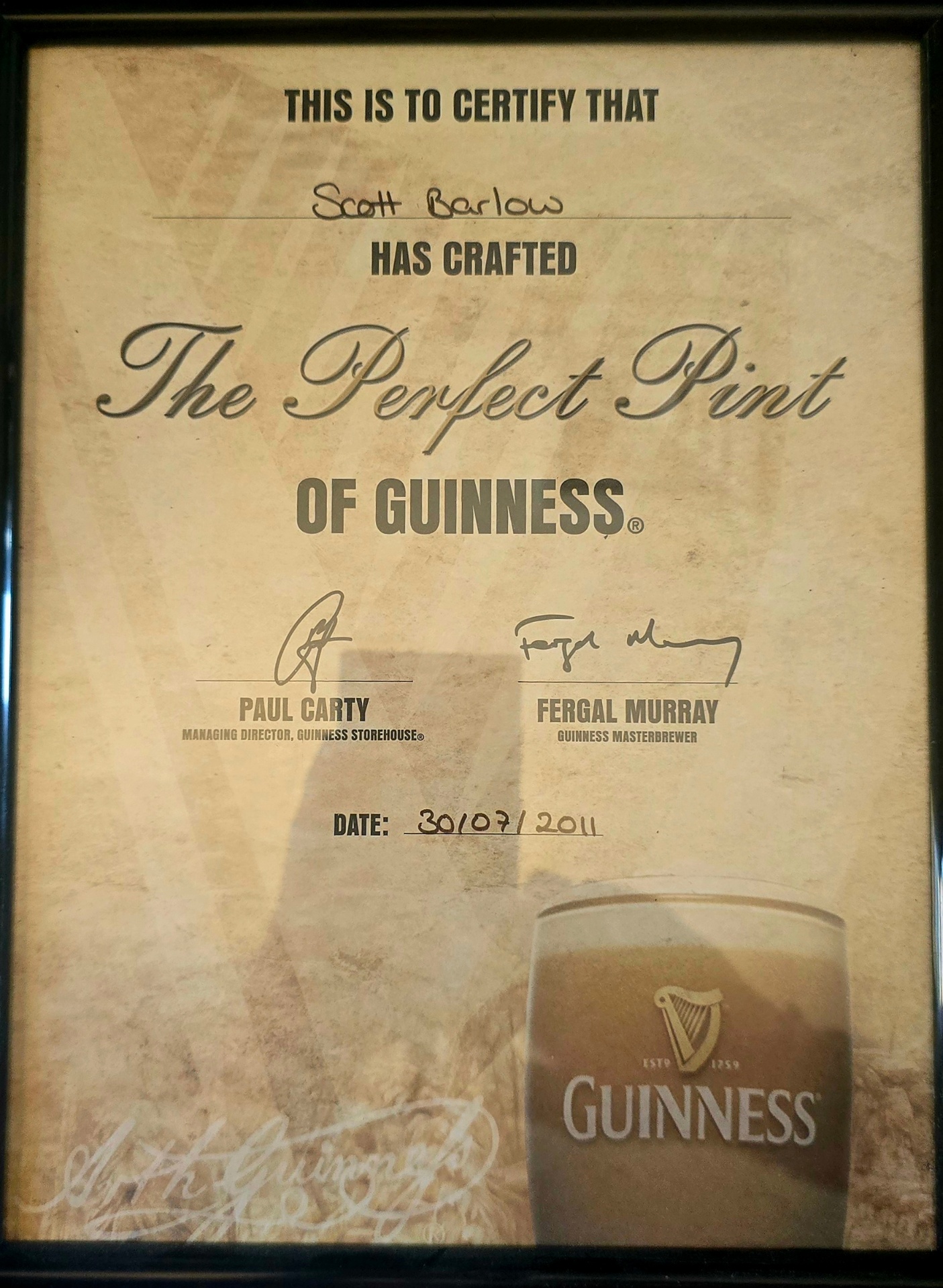
The Perfect Pint of Guinness
Guinness Storehouse, Dublin · 30 July 2011
Earned at the top of the Guinness Storehouse after performing the official two-part pour: a 45-degree tilt, a pause at three-quarters full for the surge to settle, and a slow top-up to crown the pint with that signature creamy head. Signed off by the Storehouse Managing Director and the Guinness Master Brewer themselves.
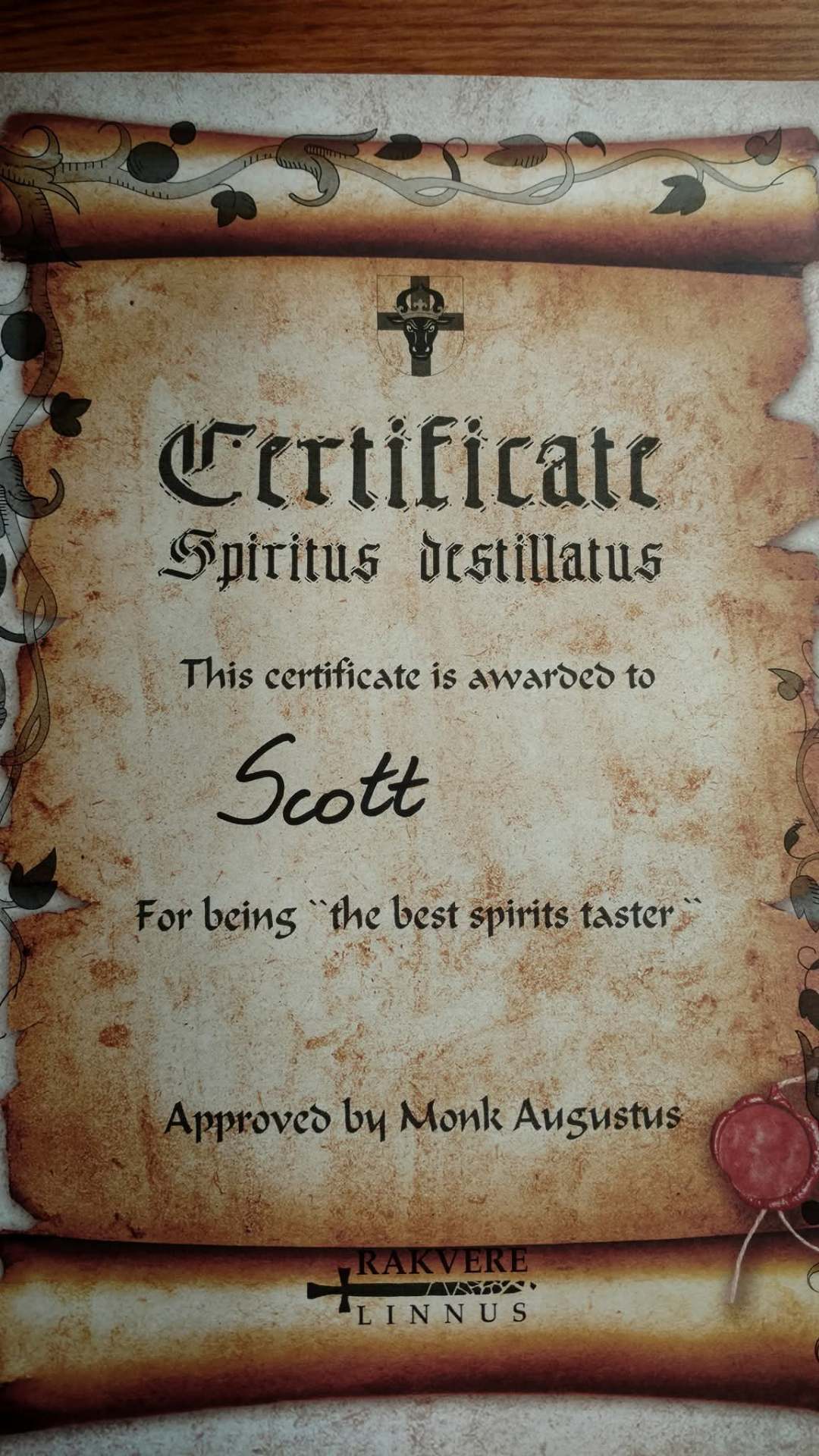
Spiritus Destillatus: Best Spirits Taster
Rakvere Linnus, Estonia
A medieval-style scroll handed out at Rakvere Castle in northern Estonia, where the on-site monks (in character) pour homemade spirits and let visitors sample their way through the cellar. Approved by Monk Augustus himself, this one declares the bearer the best spirits taster, which is either a great honor or a quiet warning.
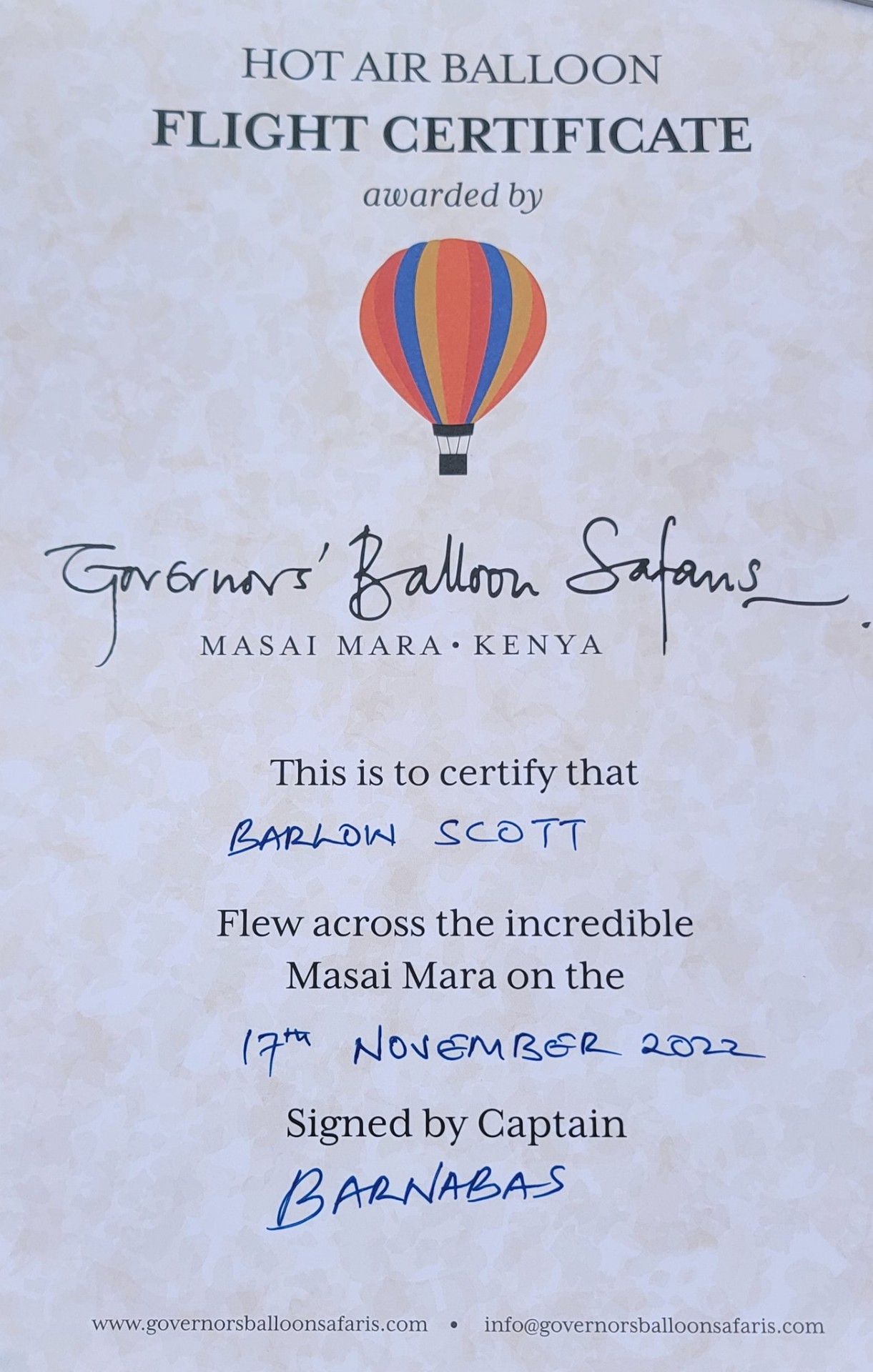
Hot Air Balloon Flight, Masai Mara
Governors' Balloon Safaris, Kenya · 17 November 2022
Issued by Governors' Balloon Safaris after a sunrise flight across the Masai Mara, drifting silently above herds of wildebeest, giraffe, and elephant as the savanna lit up gold. Signed by Captain Barnabas, with a champagne breakfast served in the bush on landing. One of the great ways to see Africa wake up.
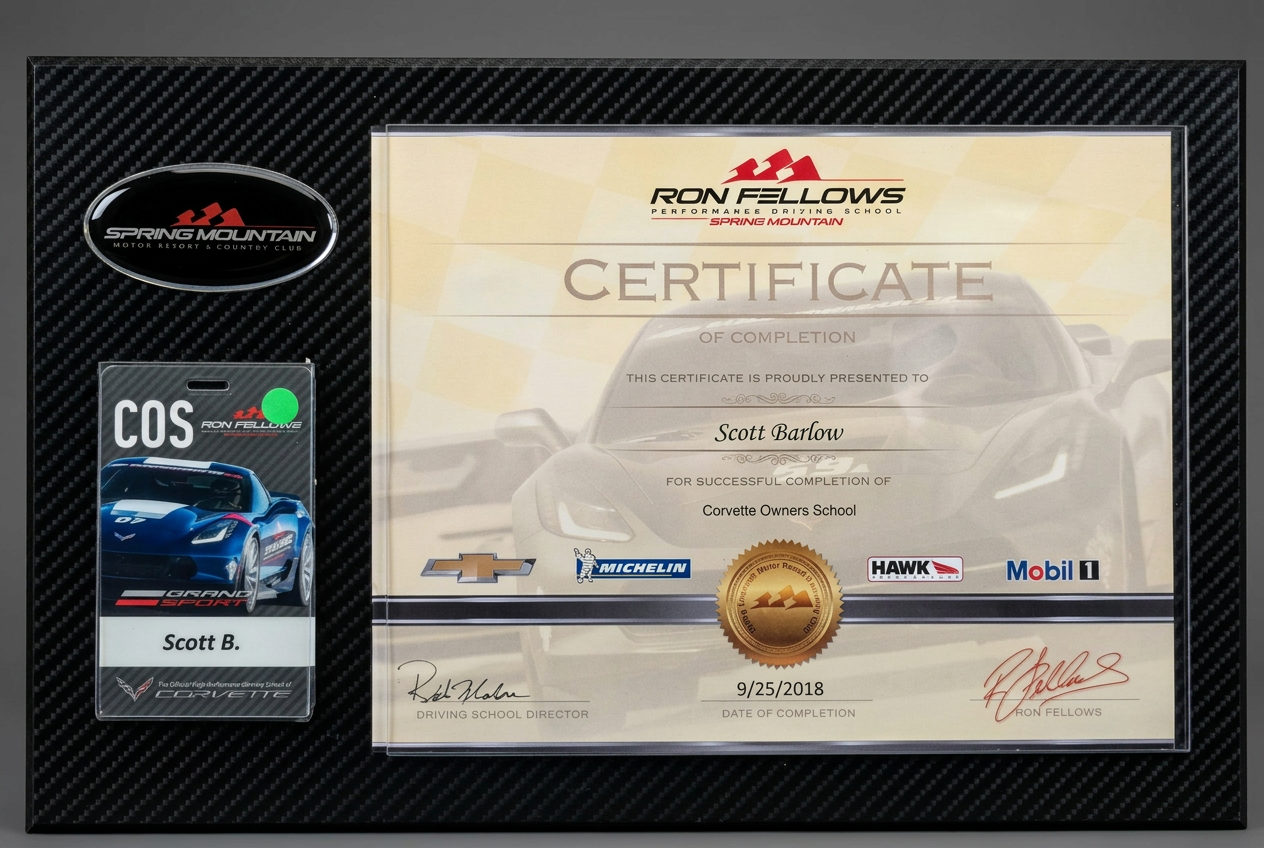
Corvette Owners School, Ron Fellows Performance Driving School
Spring Mountain Motor Resort, Pahrump, Nevada · 25 September 2018
Earned at Spring Mountain Motor Resort in the Nevada desert after two days of high-speed instruction in C7 Grand Sport Corvettes with the Ron Fellows Performance Driving School. Apex hunting, threshold braking, heel-toe downshifts, and lapping the full road course, with a paddock badge and signed certificate to prove the rear tires did not survive unscathed.
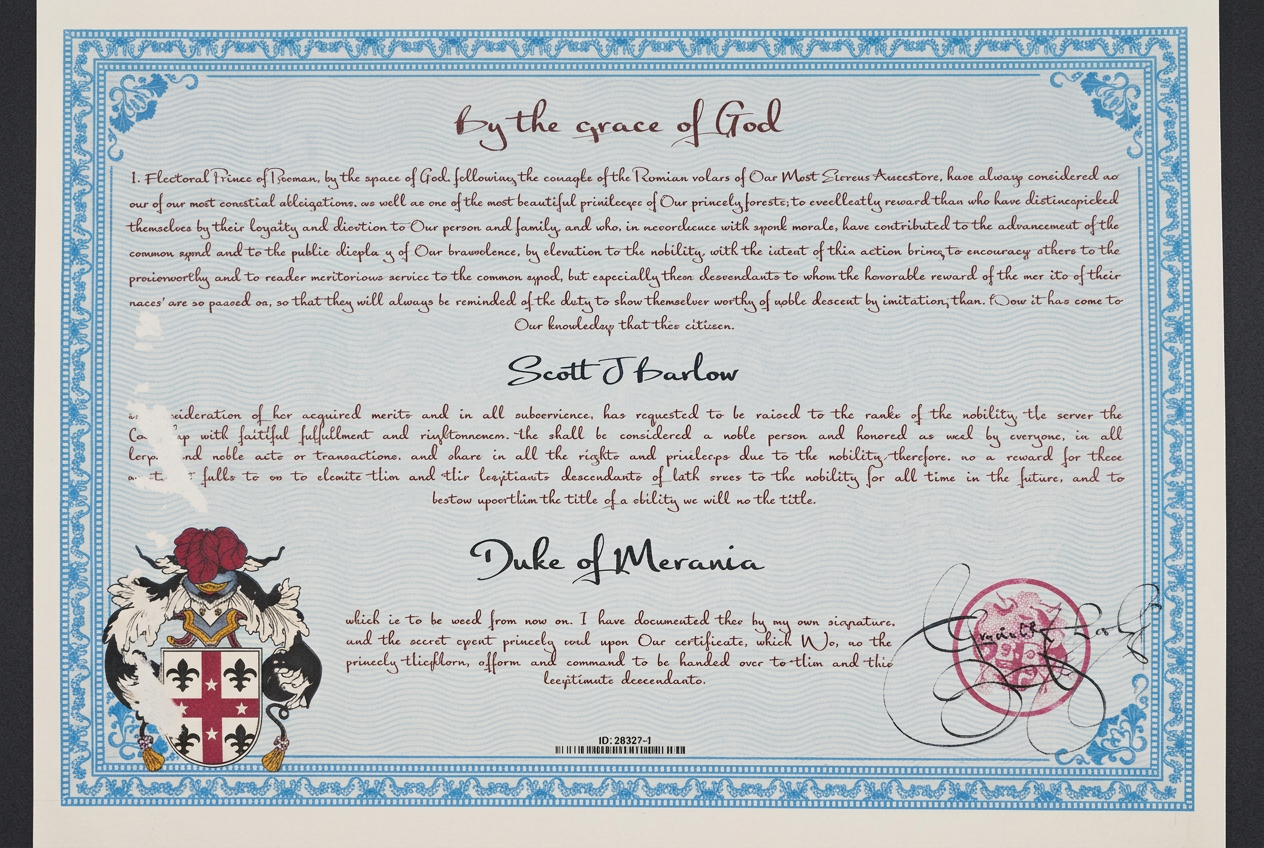
Duke of Merania, Letters Patent of Nobility
Principality of Prussia · Issued under princely seal (ID 28327-1)
A hand-styled patent of nobility, complete with heraldic crest, fleur-de-lis arms, and a crimson princely seal, bestowing upon Scott J Barlow the title of Duke of Merania. Written 'by the grace of God' in flowing calligraphy, it formally elevates Him and His legitimate descendants of both sexes to the nobility for all time. Equal parts historical curiosity and very fancy wall art, and proof that the road has occasionally come with a coat of arms.

AWS Cloud Practitioner Essentials
AWS Training and Certification · 23 June 2021
A foundational AWS course covering core cloud concepts, global infrastructure, key services, security, architecture, pricing, and support. Six hours of curriculum building the shared vocabulary needed to work fluently across AWS and the broader cloud ecosystem.

AWS Partner: Accreditation (Business)
AWS Training and Certification · 16 December 2020
The AWS Partner Network business accreditation, focused on the value proposition of AWS, partner programs, customer engagement models, and how to position cloud solutions for real-world business outcomes.

AWS Partner: APN Technology Partners Co-Selling with AWS
AWS Training and Certification · 23 June 2021
An APN business course on co-selling with AWS as a technology partner: aligning with AWS sales teams, navigating ACE (APN Customer Engagements), and building the joint motions that turn partnership into pipeline.
Stories & Musings
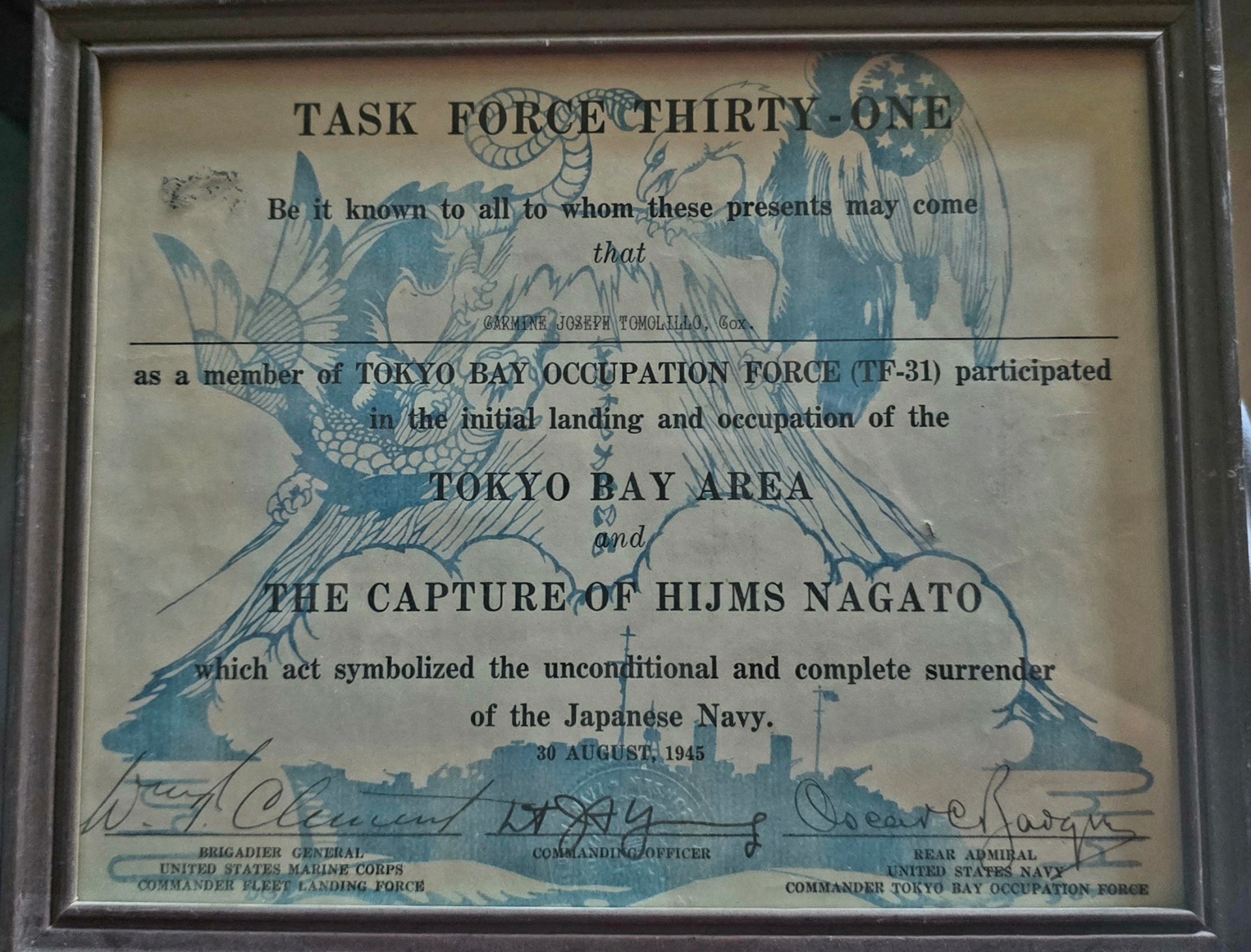
My Grandfather's Closet: WWII Memorabilia
WWII memorabilia from my grandfather's closet: Navy plaques, an Honorable Discharge, a battleship deck photo, and a folded Japanese good luck flag. A tribute to a Navy veteran, longtime Medford, MA police captain, and one of my heroes.
Field Notes · 6 min read
Corvette Racing School
How a Christmas joke, a banker's check, and a 2017 Corvette Grand Sport turned into a desert racetrack story at the Ron Fellows Performance Driving School.
Field Notes · 6 min read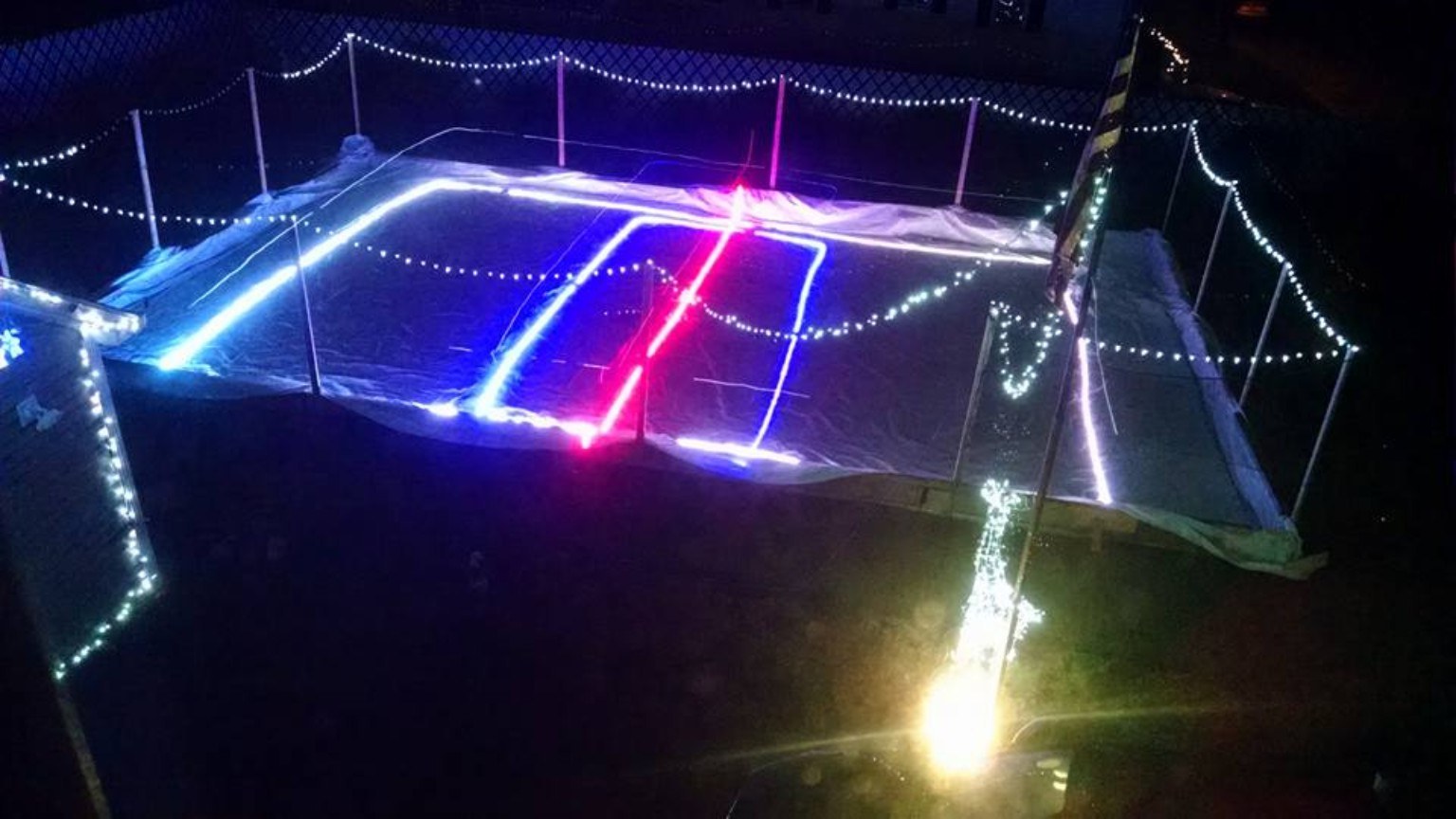
The Backyard Rink Years
Lumber, tarps, hoses, late-night floods, a homemade Zamboni, color-changing lights, and almost a decade of New England backyard hockey with the kids.
Field Notes · 8 min read
The World, One Bite at a Time
I would never call myself a foodie. I do not plan trips around tasting menus, and I am not chasing Michelin stars. But I do love trying the food of a place, because food is one of the fastest ways to understand where you are.
Field Notes · 3 min read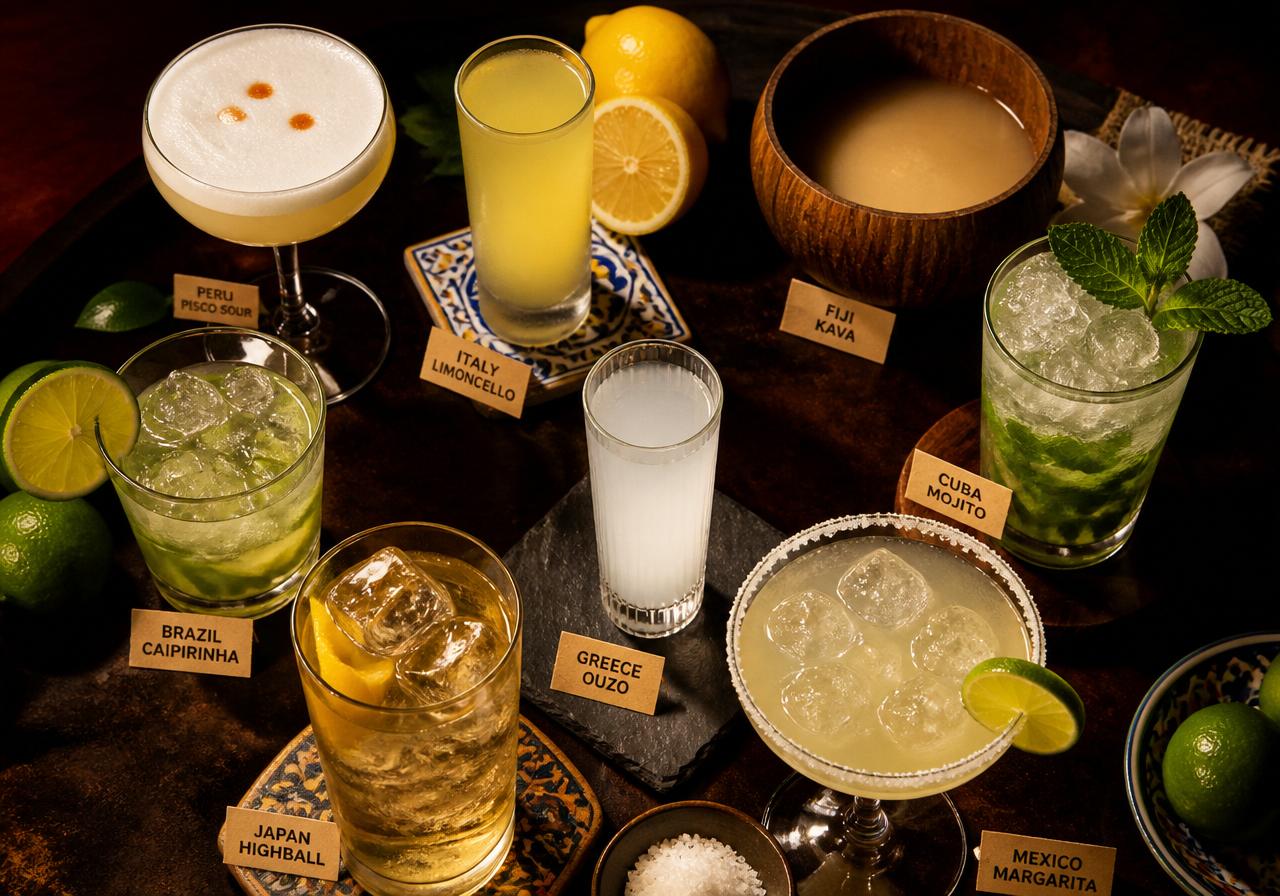
The World, One Sip at a Time
I am not a mixologist. I am barely a competent home bartender. But I am a deeply enthusiastic field researcher, and the world has handed me a very long tasting menu.
Field Notes · 4 min read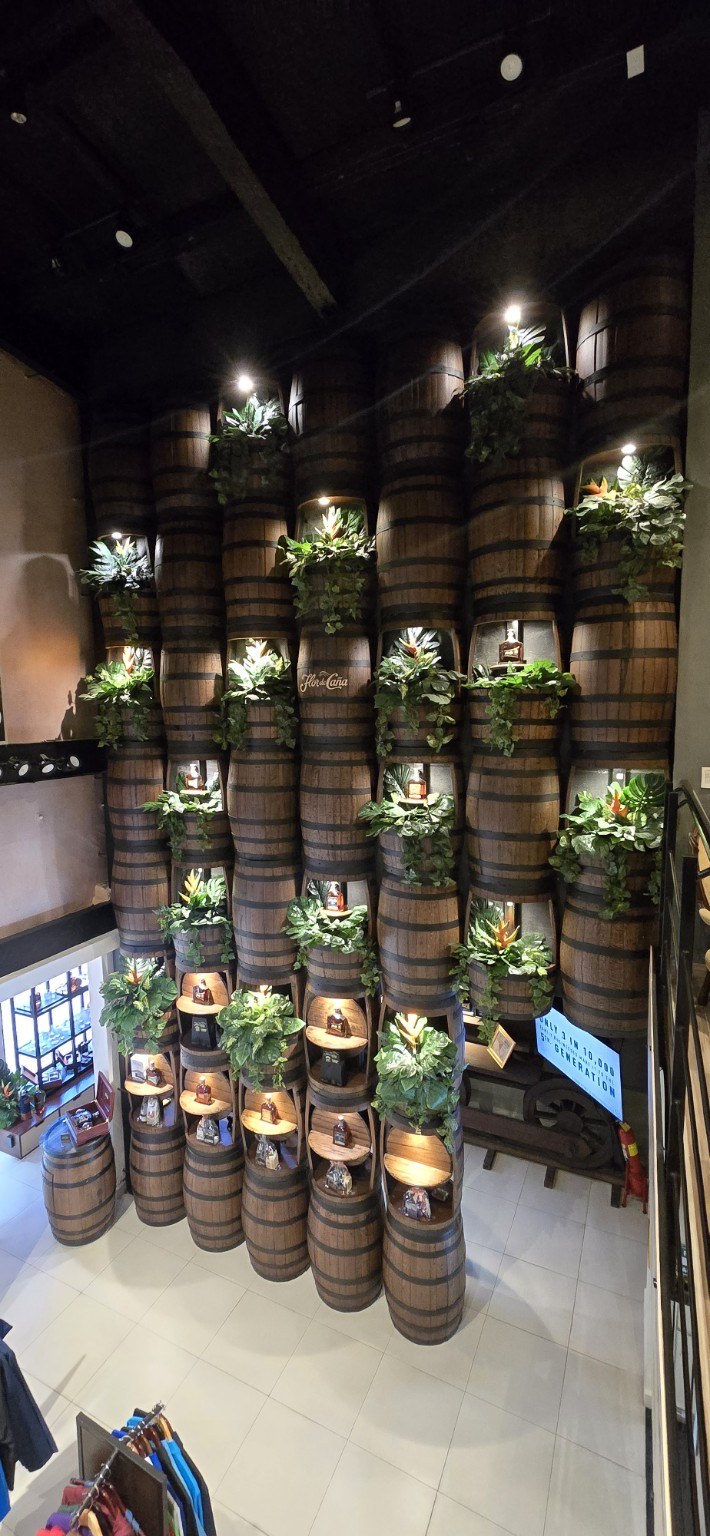
A Love Letter to Rum: Zacapa, Flor de Caña, Cihuatán, and Beyond
Zacapa in Antigua, Flor de Caña in Granada, Cihuatán in El Salvador, Bacardi in San Juan, Macorix in Puerto Plata, and a Roatán rum shop that refused to be forgotten. A short history of the bottles I keep coming back to.
Field Notes · 7 min read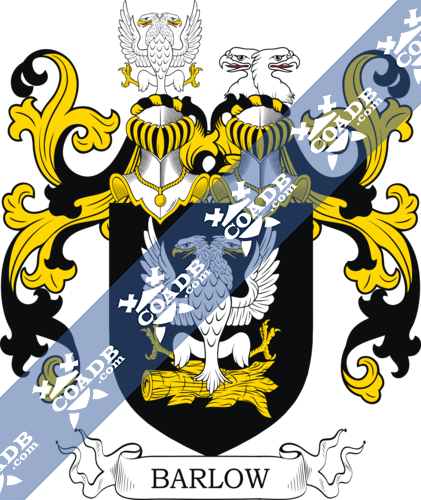
Barlow: A Name Nobody Wants to Claim
Barlow is English, but the British Isles keep passing it around. A look at the name's origins, the coat of arms, and why a surname can also be a knife.
Field Notes · 7 min read