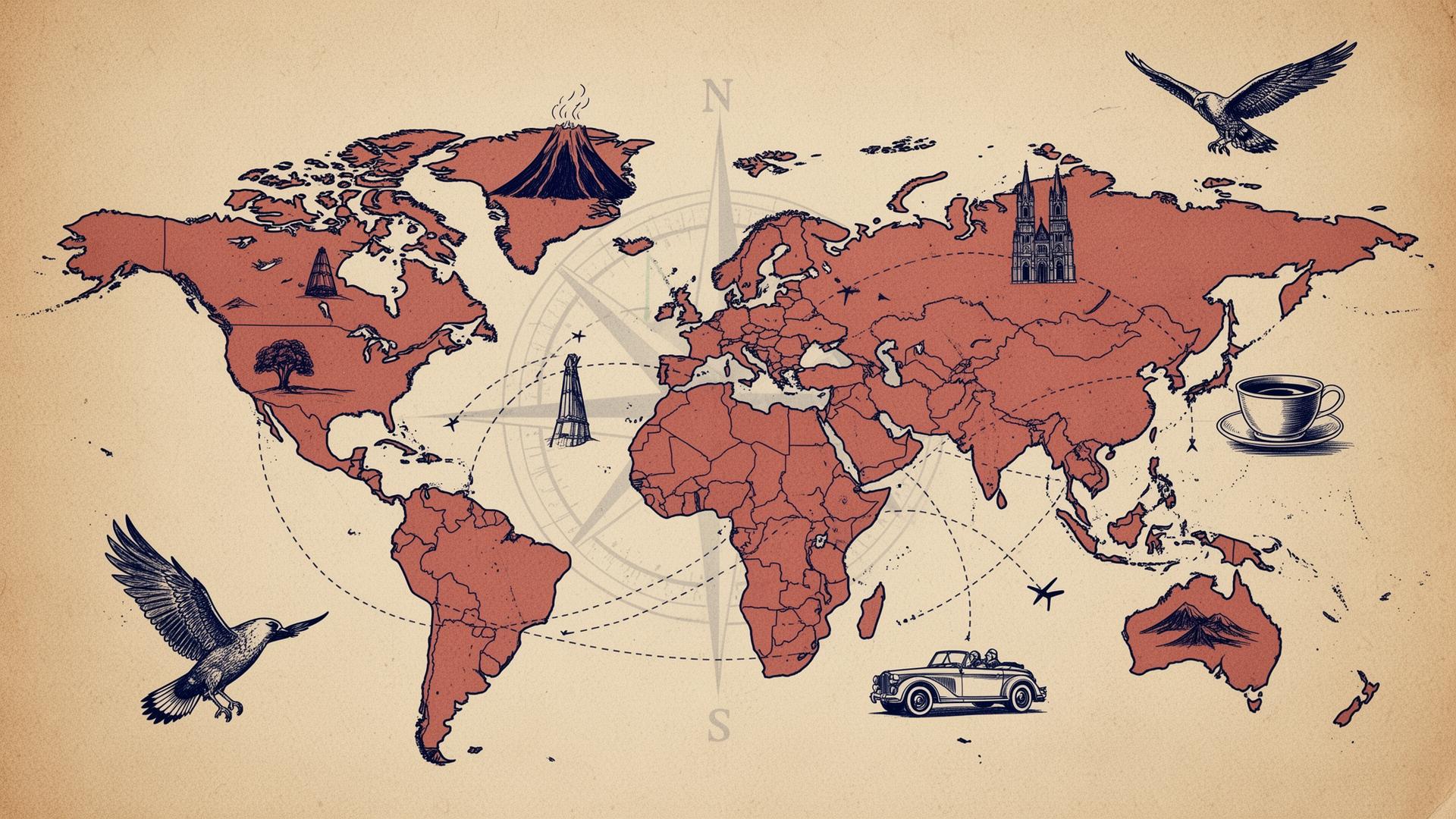
Barlow: A Name Nobody Wants to Claim
Barlow is English, but the British Isles keep passing it around. A look at the name's origins, the coat of arms, and why a surname can also be a knife.
Field Notes · 7 min read
There are names that arrive with a trumpet, a castle, and three cousins who swear they have the original family Bible. Then there is Barlow, a name that seems to have developed a remarkable international talent for plausible deniability. I went to England and was told I was Irish. I went to Ireland and was told I was Scottish. I went to Scotland and was told I was English. At some point, I stopped looking for a homeland and started appreciating the comedy: apparently the Barlows have achieved what every traveling salesperson dreams of, total market coverage with no single territory willing to accept the quota.
The short answer: Barlow is English, but complicated enough to travel well
The best-supported origin of the surname Barlow is English and habitational. That means it began as a place-name identifier: someone was from Barlow, lived near Barlow, or was associated with land called Barlow. The name is tied especially to places in Lancashire and Yorkshire, with other roots or parallel place-name origins in Derbyshire and Shropshire. The linguistic pieces are wonderfully earthy: Old English bere, meaning barley, and hlaw, meaning hill or mound, give us the idea of a barley hill. In other cases, especially Derbyshire, the first element may be bār, meaning boar, or bere again, paired with leah, meaning a woodland clearing. So depending on which Barlow you descend from, the name can carry the scent of barley fields, a hill, a boar in a clearing, or the kind of medieval real estate description that would make a modern Zillow listing sound poetic.
That fits the way surnames emerged in medieval England. A man known as John de Barlow was not necessarily making a grand dynastic claim. He may simply have been John from Barlow. Over time, from Barlow became Barlow, and the geography hardened into a surname. The joke is that the family name sounds like it should point to one exact ancestral headquarters, but the historical reality points to multiple English places and branches. It is less a single doorway and more a small network of country roads.
Why the Irish, Scottish, and English all keep passing the genealogical football
The British Isles are not tidy. They are a thousand years of migration, trade, intermarriage, conquest, religious movement, and people moving because the farm was poor, the opportunity was better, or somebody annoyed the wrong nobleman. An English surname could easily be carried into Ireland or Scotland, especially over centuries of military service, church appointments, trade, plantation settlement, marriage, or simple relocation. Once there, it could become locally rooted enough for neighbors to think of it as Irish or Scottish, even if the name itself began in England.
So the travel-office version of Barlow ancestry might read like this: English by name, British by circulation, Irish and Scottish by possible family chapters, and American by the later art of making the whole thing more confusing. Nobody rejecting you at the border is exactly wrong. They are just each holding a different chapter of a very old group project.
About that coat of arms: inspiring, not automatically inherited
The coat of arms above is the kind of thing that makes surname research immediately more exciting: eagles, helmets, mantling, a shield, and enough medieval drama to make a LinkedIn profile feel underdressed. The version most often associated with prominent Lancashire Barlows is usually described as a black shield with a silver double-headed eagle displayed, standing on a silver tree trunk, with an eagle crest and the motto Renovabitur ut aquilae tua, often translated as thy youth shall be renewed like the eagle's.
Here is the important heraldic catch, and it is not a small one. The College of Arms is very clear that there is no such thing as a coat of arms for a surname. Arms are granted or confirmed to individuals and inherited through the legitimate male line. That means two people named Barlow can have different arms, and many Barlows may have no inherited right to any arms at all. The Society of Genealogists makes the same point from a genealogy angle: arms and crests are a form of property, not surname merchandise.
That does not make the image meaningless. It makes it a historical association rather than a universal entitlement. You can use it in a blog as a visual prompt, a conversation piece, or a symbol of the Lancashire line often tied to the name. What you should avoid is saying, This is my coat of arms, unless you can document descent from the specific armigeric line. The safer phrasing is also more accurate: A coat of arms associated with a historically prominent Barlow line of Lancashire. That sentence satisfies the historians, the heralds, and the part of you that still wants the eagles.
The geography beneath the name
The Barlow name is strongly linked to northern England, especially the area around Manchester and Lancashire. The place-name root matters because place names preserve landscapes. English Heritage notes that Old English place-name elements often encode physical features, land use, and settlement history; bere, for example, appears in place names tied to barley. In plain English, Barlow is not a name born from abstraction. It comes from land: crops, hills, woods, clearings, and settlements.
That may be the best part of the name. Barlow does not begin as a crown. It begins as terrain. It is agricultural, practical, and northern. It says somebody knew the hill, knew the field, and knew how to describe a place well enough that the description survived for centuries. For a geology and geophysics guy, that is oddly satisfying. The name is not just genealogy. It is topography with descendants.
The unexpected Barlow bonus: the knife
As if a barley hill and heraldic eagles were not enough, the word barlow also became a noun for a sturdy inexpensive jackknife. Merriam-Webster traces that usage to an eighteenth-century English knife-making family named Barlow, with the first known use in 1779. This may not validate noble blood, but it absolutely validates utility. A Barlow, linguistically speaking, is also a practical tool you can put in your pocket. That feels on-brand for a family name that keeps crossing borders while everyone argues over who has to host Thanksgiving.
A reasonable family thesis
The most defensible way to tell the story is this: Barlow is an English habitational surname with deep roots in northern England, especially Lancashire and Yorkshire, plus related place-name origins in Derbyshire and Shropshire. Its meaning likely points to a barley hill, a barn-related hill, a boar clearing, or a barley clearing, depending on the place. Some Barlow families later became established in Ireland, Scotland, Wales, America, and elsewhere, which explains why the name can feel culturally mobile. The coat of arms shown is best treated as associated with a particular Barlow line, not automatically with every Barlow. The existence of multiple possible branches does not weaken the story. It makes the story more honest.
So, Scott Barlow does not need England, Ireland, or Scotland to raise a hand and say, Fine, he is ours. The name already carries enough evidence to stand on its own: a hill, a field, a clearing, an eagle, a knife, and several countries politely pretending they did not start this. That is not a lack of identity. That is a surname with range.
A surname with range: a hill, a field, a clearing, an eagle, a knife, and several countries politely pretending they did not start this.
Sources
- College of Arms, FAQs: Heraldry. https://www.college-of-arms.gov.uk/resources/faqs
- FamilySearch, Barlow Name Meaning. https://www.familysearch.org/en/surname?surname=barlow
- House of Names, Barlow History, Family Crest and Coats of Arms. https://www.houseofnames.com/barlow-family-crest
- Society of Genealogists, The Right to Arms. https://sog.org.uk/guides-and-stories/the-right-to-arms/
- English Heritage, The Origins of English Place Names. https://www.english-heritage.org.uk/visit/inspire-me/origins-of-english-place-names/
- Merriam-Webster, barlow. https://www.merriam-webster.com/dictionary/barlow